Tank capacity is often the first specification buyers use when comparing compressed-air storage vessels, but gallons alone do not determine the physical size of a tank. The dimensions of a 120 gallon tank, for example, can vary according to working pressure, diameter, length, orientation, support structure, and design requirements. The same principle applies when buyers ask what are the dimensions of a 50 gallon tank, how big is a 200 gallon tank, or what to expect from 300- and 1,000-gallon configurations.
Why Gallon Capacity Does Not Produce One Universal Tank Dimension
A tank's gallon rating describes its nominal internal volume, not its complete external footprint. Manufacturers can achieve a similar capacity through different combinations of diameter and length or height. Working pressure can also influence vessel construction and therefore the final dimensions.
For installation planning, buyers should distinguish between:
Capacity: The required internal storage volume.
Diameter: Influences floor footprint and vessel geometry.
Height or length: Determines how much vertical or horizontal space is required.
Supports: Legs, saddles, or other mounting structures add to the installation envelope.
Connections: Nozzles, valves, drains, and fittings can extend beyond the main vessel.
This is why searching for a single answer to what are the dimensions of a 50 gallon tank can be misleading. A capacity specification is only the starting point for determining actual physical dimensions.
Comparing 50, 120, 200, 300, and 1,000 Gallon Tank Configurations
Different capacity levels generally create different storage-volume requirements, but they should not be treated as fixed dimensional categories. A 50-gallon tank may be designed with a relatively compact footprint, while a 1,000-gallon vessel requires substantially greater storage volume. However, the exact diameter, height, or length depends on the selected engineering configuration.
For buyers comparing dimensions of a 120 gallon tank with larger capacities, the most useful approach is to compare the complete technical drawings rather than capacity labels alone.
| Capacity | What Buyers Should Compare |
|---|
| 50 gallons | Diameter, overall height/length, supports, and connections |
| 120 gallons | Vessel dimensions, orientation, mounting arrangement, and clearance |
| 200 gallons | Diameter-to-length/height ratio and installation footprint |
| 300 gallons | Overall envelope, access requirements, and connection locations |
| 1,000 gallons | Vessel geometry, support structure, transport route, and installation space |
These capacities can therefore have different dimensional configurations depending on the application. A supplier should confirm the final dimensions based on the required pressure rating and design specifications.
How Working Pressure Changes Diameter and Length
Working pressure is an important factor when determining vessel construction. A tank designed for a particular pressure requirement must meet the applicable engineering and manufacturing requirements for that service. This can influence material selection, wall construction, component specifications, and the resulting vessel configuration.
Consequently, buyers should not compare dimensions of a 120 gallon tank or a 300-gallon tank without also confirming the pressure requirement. Two tanks with the same nominal capacity may have different designs when their working conditions are different.
When requesting a quotation, buyers should provide the required capacity together with working pressure, operating conditions, applicable standards, material requirements, and installation orientation. This gives the manufacturer the information needed to determine an appropriate vessel configuration.
How Vertical and Horizontal Designs Affect Footprint
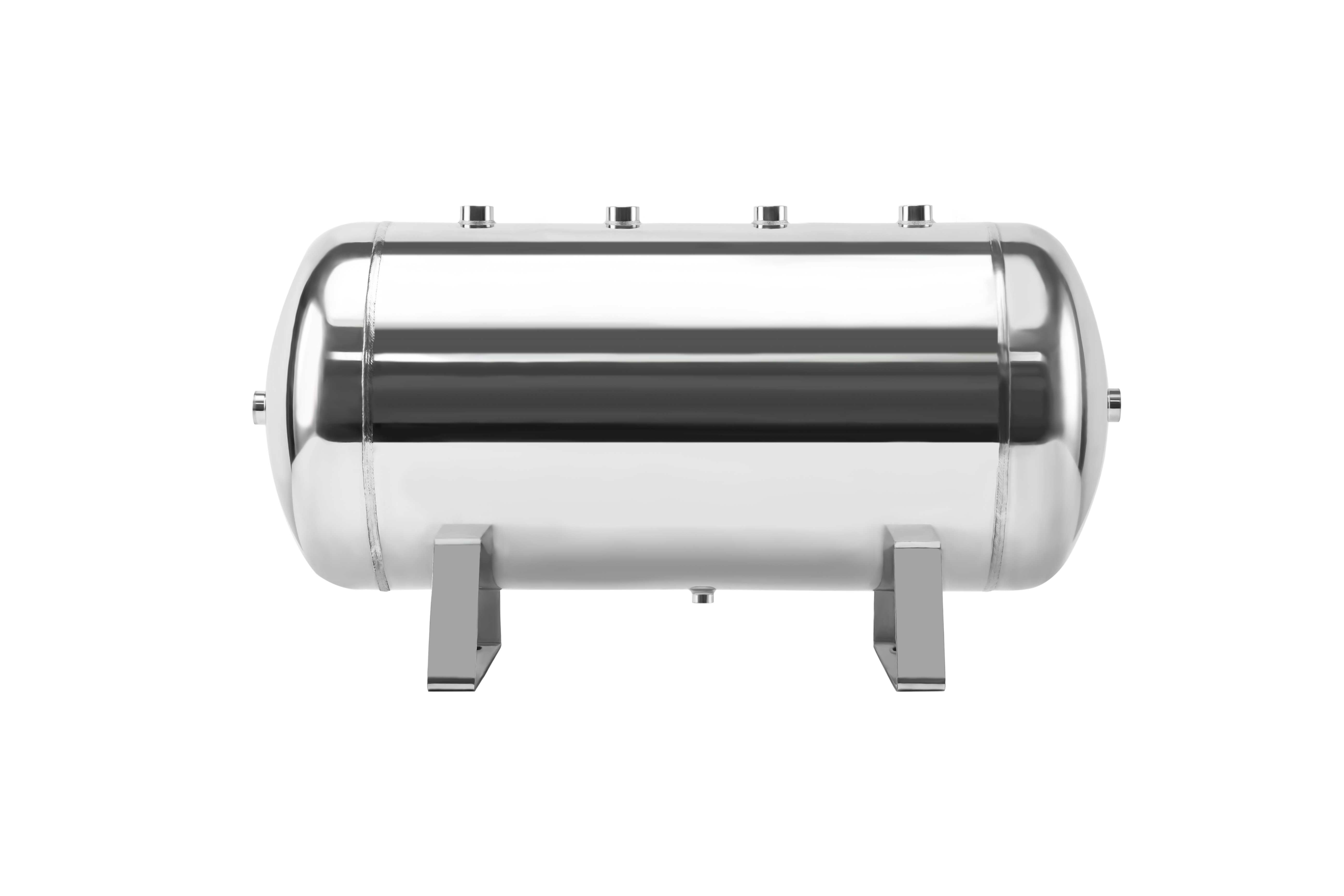
Orientation can significantly change how a tank uses available space. A vertical configuration generally uses more floor area in the upward direction, while a horizontal configuration extends farther across the floor. Neither configuration is universally suitable because installation conditions vary between facilities.
For example, a location with limited floor space but sufficient ceiling clearance may favor a vertical arrangement. A facility with restricted overhead clearance may instead need to evaluate a horizontal configuration.
The actual dimensions of a 120 gallon tank, 200-gallon tank, or larger vessel should therefore include the complete installation envelope rather than just the pressure-vessel body. Support structures, valves, piping connections, maintenance access, and lifting requirements also need to be considered.
What Drawings Buyers Should Request Before Installation
Before purchasing a tank, buyers should request a detailed dimensional drawing showing the overall height, length, outside diameter, support dimensions, nozzle locations, connection sizes, and other projections. For projects with specific space or installation constraints, working with an air receiver tank manufacturer that can confirm these details during the quotation stage can help buyers avoid dimensional conflicts later. YCZX can provide dimensional information based on the required capacity, pressure rating, orientation, and installation requirements, allowing buyers to review the proposed tank configuration before production. The drawing should make clear which dimensions belong to the vessel itself and which belong to external components.
Installation teams should also check the route used to move the tank into position. Door openings, corridors, ceiling height, lifting equipment, foundation conditions, and surrounding machinery can all affect installation even when the final location appears large enough.
This is especially important for larger configurations. Knowing the dimensions of a 300 gallon tank or a 1,000-gallon tank is useful, but knowing the complete transportation and installation envelope is more important for project planning.
Conclusion
There is no single universal set of dimensions for 50, 120, 200, 300, or 1,000 gallon tanks. Capacity defines the required storage volume, while pressure rating, vessel geometry, orientation, supports, connections, and design standards determine the physical configuration. Buyers searching for dimensions of a 120 gallon tank or asking how big is a 200 gallon tank should therefore use capacity as a starting point and request a manufacturer-approved dimensional drawing before finalizing installation plans.
FAQs About Dimensions of a 120 Gallon Tank
What are the dimensions of a 50 gallon tank?
There is no universal dimension because manufacturers can use different diameter, height, length, pressure, and orientation combinations. The exact dimensions should be confirmed from the supplier's drawing.
What are the dimensions of a 120 gallon tank?
The dimensions of a 120 gallon tank depend on its pressure rating, configuration, orientation, support structure, and design requirements. A dimensional drawing is the appropriate reference for installation.
How big is a 200 gallon tank?
The physical size of a 200-gallon tank varies by design. Buyers should confirm diameter, height or length, supports, connections, and maintenance clearance rather than relying on capacity alone.
What are the dimensions of a 300 gallon tank?
A 300-gallon tank can have different dimensional configurations depending on its pressure and design requirements. The supplier should provide the final overall dimensions before installation.
What are the dimensions of a 1000 gallon tank?
A 1,000-gallon tank requires a significantly larger storage volume, but its exact footprint and height depend on the selected vessel design, pressure rating, orientation, and support structure.
Why can tanks with the same capacity have different dimensions?
The same nominal capacity can be achieved using different vessel geometries. Diameter, length, height, pressure requirements, orientation, and support design can all change the final external dimensions.