Compressed-air systems form the backbone of modern industrial manufacturing, and air receivers serve as the core hardware for gas storage, pressure stabilization and liquid separation. When selecting an air receiver, working pressure is one critical metric, while structural form and practical application scenarios are equally decisive. Different tank structures bring clear differences in floor-space occupation, mechanical stress distribution, installation convenience and maintenance workload. A vertical tank and a horizontal tank are designed for completely different site conditions and gas-storage demands. Selecting the wrong structure leads to difficult installation, unstable operation or unnecessary material waste.
As an experienced professional pressure-vessel manufacturer, YCZX designs and fabricates vertical and horizontal air receivers to meet diversified customer requirements. We carry out customized engineering design according to customers' plant layout, space constraints, gas volume and pressure parameters. This article elaborates on the two mainstream air-receiver structures that YCZX manufactures — vertical and horizontal — analyzing their unique characteristics, applicable scenarios, key engineering differences, and demonstrating YCZX's comprehensive manufacturing capability and strict quality-assurance system for both structural forms.
Vertical Air Receivers
Vertical air receivers are the most widely adopted type for standard industrial compressed-air systems. Their main feature is a tall, upright cylindrical structure with a small floor footprint, which fully utilizes vertical overhead space inside workshops.
For factories with limited ground area but sufficient ceiling height, vertical air receivers are the preferred solution. They occupy minimal valuable workshop floor space and can be installed beside air compressors without blocking production and logistics passages. The elliptical heads at both ends are welded to the cylindrical shell, with inlets, outlets, drain ports and safety-valve nozzles arranged rationally for daily condensate drainage and safety protection. Because the vessel stands upright, condensed water naturally settles to the bottom of the tank, and a low-position drain port allows efficient discharge without disturbing gas flow.
YCZX's custom vertical air receivers can be manufactured from carbon steel or stainless-steel materials. We optimize nozzle layout according to customers' pipeline routing, avoiding unnecessary bends that add pressure drop. Our production process includes plate rolling, automatic girth-seam welding, non-destructive testing and hydrostatic pressure testing. Carbon-steel tanks receive shot-blasting followed by epoxy anti-corrosion painting; stainless-steel vessels can be polished up to 600 grit for high-cleanliness applications in food, pharmaceutical and semiconductor industries. Whether for a small workshop pneumatic circuit or a medium-volume industrial gas-buffer installation, our vertical receivers maintain stable performance and long service life.
A key YCZX engineering consideration for vertical tanks is support stability. The bottom head, support legs or base ring, and lifting lugs are designed together so that the upright vessel remains safe during transport, hoisting and on-site mounting. Welding between supports and shell is controlled to avoid local stress concentration, and all connections are verified under the hydrostatic test.
Horizontal Air Receivers
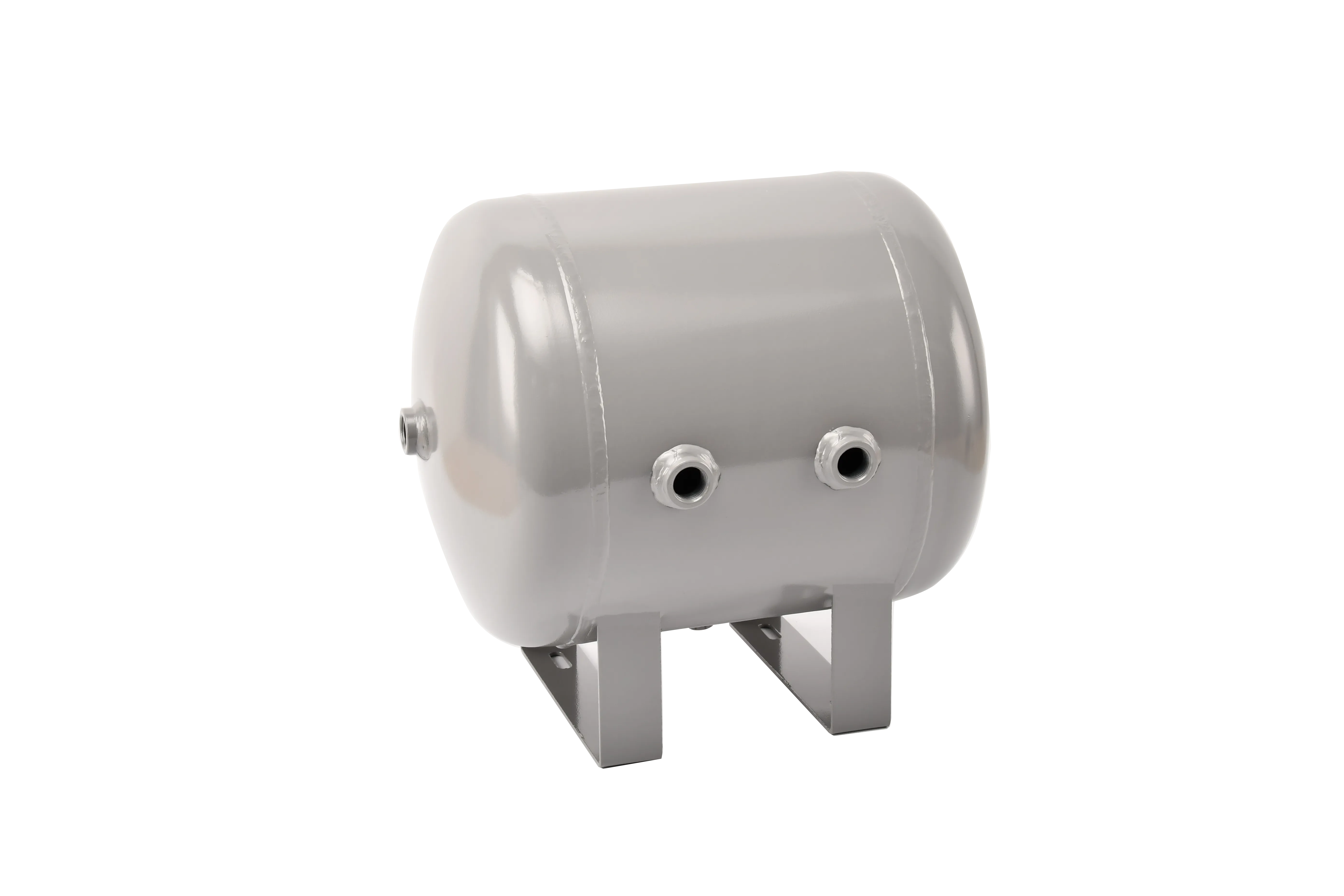
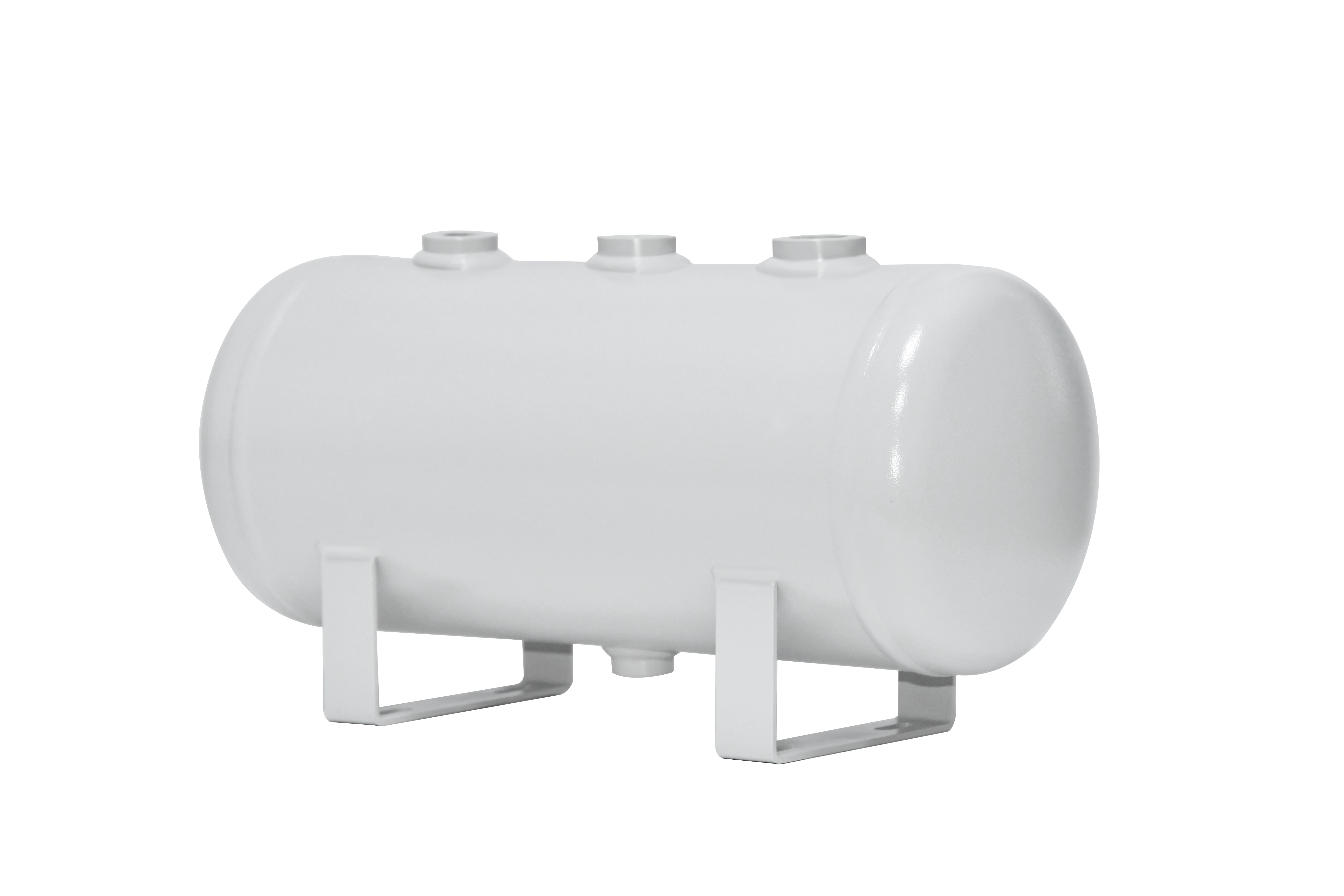
Horizontal air receivers feature a horizontally placed cylindrical body supported by two or more welded saddle legs. The core advantage is a low center of gravity, which delivers outstanding structural stability. Compared with vertical tanks, horizontal air receivers are much easier to install, inspect routinely, maintain and replace components on.
This structure suits sites with ample floor space but limited building height, or projects requiring high operational stability. Many heavy-industry, mining, energy, logistics and large packaging production lines choose horizontal receivers. The low center of gravity makes them more resistant to vibration generated by air compressors and nearby equipment, reducing the risk of pipeline-connection loosening. The longer shell also improves gas-liquid separation: slower horizontal flow gives more residence time for oil droplets, rust particles and condensed water to settle under gravity before gas moves downstream to pneumatic actuators.
At YCZX, we design saddle supports matched to the tank weight and working pressure for every horizontal receiver. Saddle spacing and contact angle are calculated to distribute load evenly and avoid localized bending stress on the shell. Welding between saddles and body is strictly controlled, and nozzle reinforcement calculations are completed for every connection. All critical welds undergo radiographic or penetrant non-destructive testing. For export orders, horizontal receivers can be fabricated compliant with ASME Section VIII Div.1, PED and other international standards, with complete certification documents for overseas project acceptance.
Choosing Between Vertical and Horizontal
The decision between vertical and horizontal structures rests mainly on site conditions rather than preference. Choose a vertical receiver when floor space is scarce, ceiling height is available, condensate drainage is routine, and a compact footprint matters. Choose a horizontal receiver when ground space is generous but roof height is limited, vibration resistance and easy maintenance are prioritized, or a large storage volume must sit in a low-height plant room. In both cases, volume, working pressure, medium and temperature remain the governing design parameters; structure only determines how the vessel fits the site. YCZX engineers review these factors together with customers and recommend the most suitable configuration instead of forcing a standard catalog item.
YCZX: Custom Air-Receiver Manufacturing with Full-Process Quality Control
Whether customers select a vertical or a horizontal air receiver, YCZX applies the same high standards throughout the entire manufacturing workflow. Our strength lies in providing fully customized pressure vessels tailored to site conditions and technical requirements, rather than only supplying standard off-the-shelf tanks.
The customization process begins with technical communication. Our engineers analyze available installation space, working pressure, medium, temperature, pipeline layout and local regulatory codes, then recommend the most suitable structure, material and size. Raw-material inspection is the first quality checkpoint: all steel plates carry authentic mill test certificates, with complete traceability from incoming plate to finished vessel. Welding is performed by certified welders under validated WPS and PQR procedures. Post-weld NDT, hydrostatic pressure testing, surface treatment and final inspection form a multi-layer quality-control system. We also deliver a complete documentation package including design drawings, material certificates, welding records, test reports and certification files to support domestic and international project audits.
We understand that every industrial site has unique spatial limits and operational demands. A tank that suits one factory layout may not fit another. YCZX's flexible customization service resolves this pain point, delivering reliable, code-compliant vessels precisely matched to each working environment.
Vertical and horizontal air receivers are the two mainstream structural forms classified by arrangement and application. Vertical tanks save floor space for plants with limited ground area but sufficient height, while horizontal tanks provide excellent stability and convenient maintenance for wide, low-ceiling sites. Selecting the correct structure is the foundation of safe, efficient and economical gas-storage system operation.
With deep experience in pressure-vessel design and manufacturing, YCZX provides custom vertical and horizontal air receivers for global industrial customers. Our full-process quality-control system ensures every tank meets required safety standards, whether for small factory compressed-air buffering or large industrial storage circuits.
If you are looking for a reliable custom air receiver matched to your site layout and process requirements, choose YCZX. We provide professional engineering consultation, tailor-made design, precise fabrication and complete after-sales support to build the ideal pressure-vessel solution for your project.