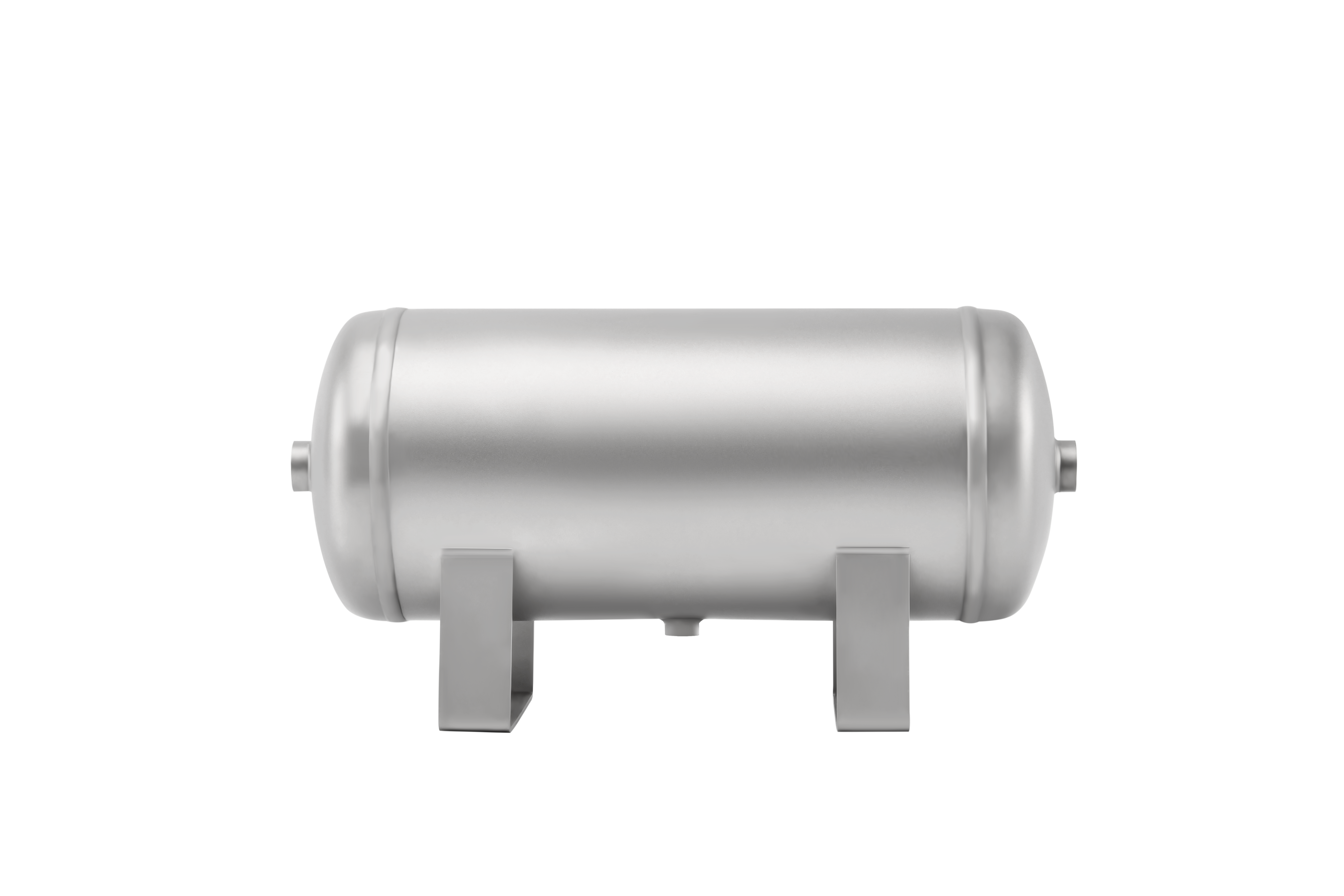
Two quotes for the same 60-litre receiver land in your inbox on the same morning. Same working pressure. Same G1/2 ports. Same footprint on the shop floor. One is cheaper.
The number that explains the gap is not in either quote. It is a 3 mm dimension on the drawing — and most buyers never look at it.
What actually changes between the two materials
Carbon steel and stainless steel both hold compressed air safely. What separates them is not strength; it is what the air and the environment do to the tank over ten years.
Carbon steel is stronger per millimetre and cheaper per litre. It needs protection: shot blasting, a powder coating system, and a drainage routine. Stainless steel costs more at the counter and gives you a surface that does not rust, does not shed oxide into your air line, and can be polished to a controlled finish.
Neither is "better". One is appropriate.
The three lines that decide the outcome
Ask any supplier for these three values before you compare prices. If they cannot put them in writing, the cheap quote is not a quote — it is a guess.
1. Material grade. "Carbon steel" is not a specification. Q235B, Q345R and Q355B behave differently under pressure and at low temperature. "Stainless steel" is not one either: 304 and 316L diverge the moment chlorides appear. On a real production drawing the grade is stated, not implied.
2. Design pressure and design temperature. Working pressure is what your compressor delivers. Design pressure is what the vessel is built to survive, and it drives wall thickness. A 60 L nominal receiver designed for 1.25 MPa at 100 °C, with a 3 mm shell and D325×3 dished heads, is a different object from a 60 L receiver built to a lower class and sold at the same nominal size.
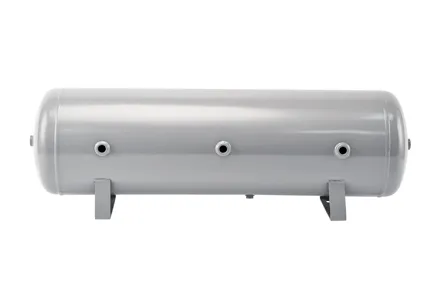
3. Surface requirement, written as a process. "Painted" means nothing. "Shot blasted to Sa2.5, powder coated in RAL 7037, salt spray tested" is an instruction a workshop can follow and a buyer can verify. On stainless, the equivalent is "weld seams ground, pickled and passivated, mirror finish" — again, a process, not an adjective.
When carbon steel is the right answer
Indoor installation, stable humidity, routine condensate drainage
Large volumes, where cost per litre dominates the decision
Environments where a certified coating system matches the exposure
When stainless steel earns its price
Food, beverage, pharmaceutical, medical and electronics lines, where air quality is a product risk
Coastal, chemical or washdown environments, where a carbon steel coating fails at welds, brackets and edges first
Any process that cannot tolerate iron oxide particles reaching a filter, a valve or the product
Where aluminium fits
Aluminium receivers make sense when weight and portability matter more than volume: mobile equipment, small on-board systems, tanks that move rather than bolt down. Pressure class and certification scope vary by project, so treat aluminium as an engineered item, not a catalogue item — confirm alloy, pressure rating and certification for the specific duty before you order.
Three assumptions that cost money
"Stainless is always the safe choice." Not automatically. 304 pits in chloride-rich air where 316L holds, and a stainless tank with a poorly passivated weld corrodes at the seam itself.
"A bigger tank fixes pressure drop." Storage does not repair an undersized header. Size the pipe before the vessel.
"The coating is cosmetic." On carbon steel the coating is the corrosion allowance you can see. A thin coat at a bracket, or a skipped edge, is where the failure starts.
Ten years, not one purchase order
The purchase price is the smallest number in the calculation. Add filter replacement, coating repair, condensate-related downtime, and the year the tank gets replaced. A stainless receiver that outlives two carbon steel units is not expensive — it is deferred.
How we document it
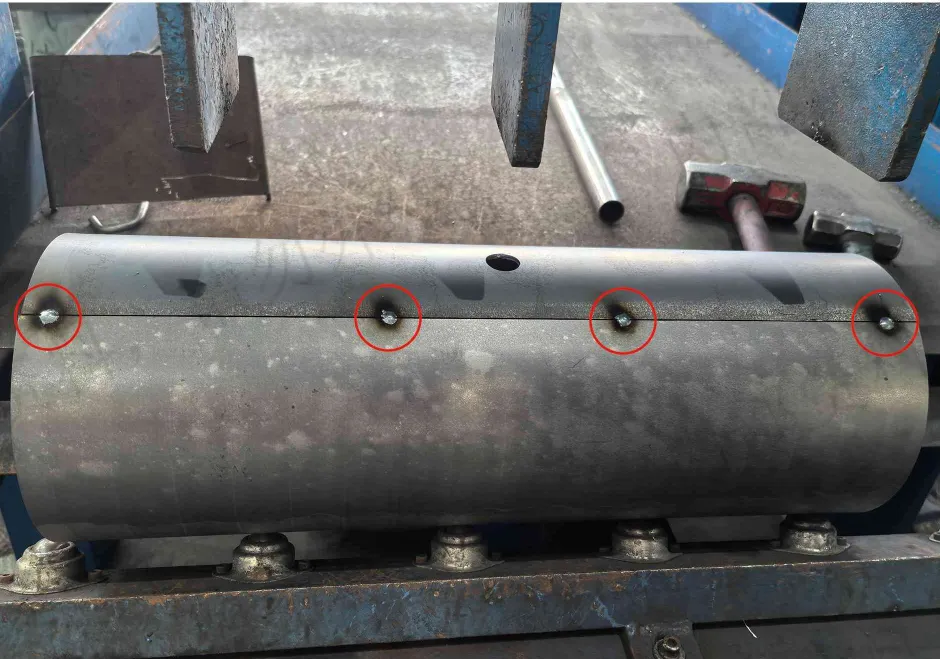
At YCZX, every receiver leaves with paperwork that makes these claims checkable, not just stated: material certificates, non-destructive testing on pressure-bearing welds, hydrostatic and air-tightness test records, coating thickness and salt spray reports where applicable. Stainless vessels are ground, pickled and passivated; carbon steel vessels are shot blasted to Sa2.5 and powder coated in the colour you specify.
A drawing that omits grade, design pressure and design temperature is not a drawing — it is a brochure.
Since 2013 we have built and customised air receivers under CE, ASME and DOSH certification, shipped to 155 countries.
Before you sign
Send us your working pressure, your environment (indoor, coastal, washdown, food contact) and your volume. We will come back with a material recommendation, a drawing with the three lines filled in, and the certificate list for your destination market — usually within a few working days.