Many customers consulting custom‑built pressure vessels raise a frequent technical question: can carbon steel and stainless steel be reliably welded together? In custom air‑receiver projects, this scenario often appears when designers plan carbon‑steel tank shells paired with stainless‑steel nozzles, flanges or outlet ports. The short answer is yes, carbon steel and stainless steel can be welded, but dissimilar‑metal welding is far more complex than welding two identical steel grades. Improper process selection will create hidden risks including brittle intermetallic phases, stress corrosion cracking, weld‑zone embrittlement and residual welding stress. These defects may remain invisible during factory inspection and gradually expand under cyclic pressure, temperature fluctuation and humid service environments, threatening the long‑term safety of pressure‑vessel equipment. For custom air receivers used in compressed‑air stations, mining machinery and coastal industrial facilities, dissimilar‑metal joints demand rigorous engineering evaluation, qualified welding consumables, standardized procedures and strict post‑weld inspection — areas where many general fabricators lack sufficient experience.
To understand the challenges of carbon‑steel‑to‑stainless‑steel welding, it is necessary to analyse their fundamental material differences. Common pressure‑vessel carbon‑steel grades such as Q345R feature good plasticity, low cost and excellent weldability, making them ideal main‑shell materials for most industrial air receivers. Stainless steel (typically 304 or 316L) delivers outstanding anti‑corrosion performance, resisting rust under moisture, salt‑spray and chemical vapour. However, these two material families differ greatly in thermal‑expansion coefficient, thermal‑conductivity rate, chromium‑nickel alloy content and phase transformation behaviour. When they are fused together during welding, uneven heat expansion and contraction generates high residual stress across the joint boundary. More critically, mixing carbon from carbon steel with chromium from stainless steel creates chromium‑carbide precipitation along grain boundaries. This phenomenon depletes chromium near the weld and heat‑affected zone, resulting in inter‑granular corrosion susceptibility. If welding parameters or filler metal are chosen incorrectly, the dissimilar joint becomes the weakest link of the whole pressure vessel.
Selecting appropriate welding filler material stands as the most critical factor for successful dissimilar‑metal welding. Ordinary carbon‑steel welding wire cannot be used; standard stainless‑steel wire for welding stainless‑steel‑to‑stainless‑steel joints is also not fully suitable. In real‑world pressure‑vessel manufacturing, high‑nickel alloy welding consumables are normally adopted for carbon‑steel‑stainless‑steel dissimilar joints. Nickel‑rich filler metal moderates the sharp transition of chemical composition between base metals, suppresses brittle hard‑phase formation, reduces residual thermal stress and improves the joint’s resistance to corrosion and cracking. Apart from filler selection, heat‑input control is equally vital. Excessive heat input extends the high‑temperature residence time of the weld pool and accelerates harmful carbide precipitation. Insufficient heat input leads to incomplete fusion and lack‑of‑penetration defects. Therefore, welding current, voltage, travel speed and inter‑pass temperature must be strictly defined in the formal Welding Procedure Specification (WPS). Pre‑heating requirements also differ greatly from homogeneous‑steel welding. Blindly copying carbon‑steel welding parameters will inevitably produce sub‑standard dissimilar‑metal welds.
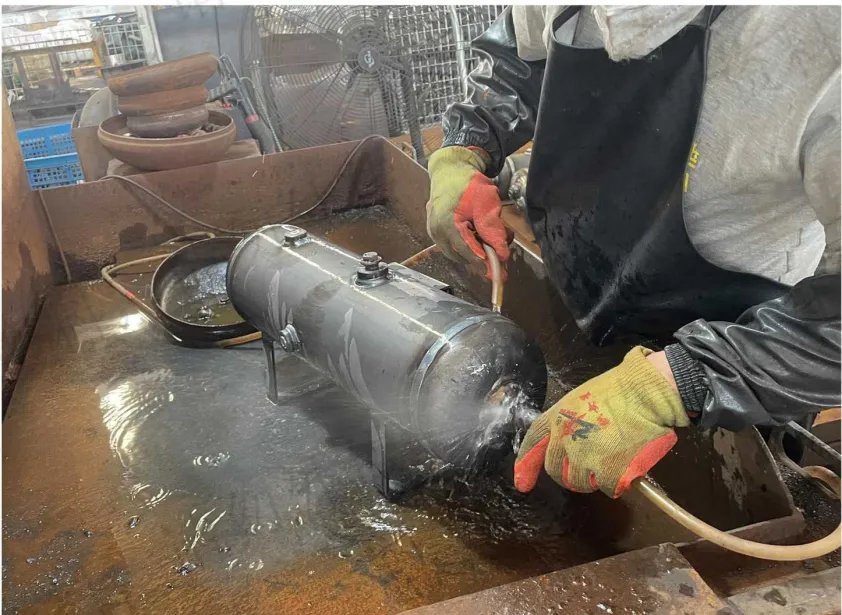
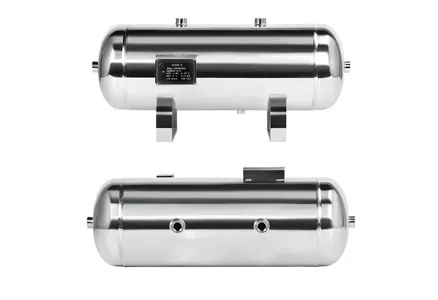
In custom air receiver practical applications, designers should also evaluate whether dissimilar‑metal welding can be avoided in the first place. At YCZX, our engineering team always carries out forward‑looking review for every custom project. If service conditions permit, we will suggest adopting full carbon‑steel construction or full stainless‑steel construction to eliminate dissimilar‑joint risks entirely. When customers insist on mixed‑material design for cost‑benefit reasons — for example, a Q345R carbon‑steel main shell with 304 stainless‑steel threaded nozzles for corrosion‑prone outlet positions — YCZX will implement a full set of dissimilar‑metal process controls. Before welding commences, weld procedure qualification records are confirmed. Operators with valid dissimilar‑metal welding qualifications perform fabrication. We control heat‑input value precisely, clean the groove thoroughly to avoid carbon contamination, and execute multi‑pass welding with controlled inter‑pass temperature. After welding completes, every dissimilar joint receives comprehensive visual inspection. Depending on project specification requirements, penetrant testing or radiographic non‑destructive examination is applied to detect surface and subsurface flaws. Hydrostatic pressure testing is then performed on the finished tank to verify overall joint tightness under working pressure.
Unfortunately, some component manufacturers lack mature dissimilar‑metal‑welding experience. They treat carbon‑steel‑stainless‑steel joints as ordinary homogeneous welds, using unspecified generic welding wire and copied‑from‑carbon‑steel parameters. Defects generated in this way often do not show obvious failure signs at the factory acceptance stage. Once the custom air receiver is put into field service, under combined action of cyclic internal pressure, temperature change and humid air or coastal salt mist, corrosion cracks may initiate from the dissimilar‑weld heat‑affected zone. Repairing such in‑service pressure‑vessel cracking is extremely costly, often requiring equipment shutdown, component replacement and regulatory re‑certification. For end‑users, the hidden cost caused by unqualified dissimilar‑metal welding far outweighs the small saving achieved during procurement.
It is also worth noting that post‑weld surface treatment adds another layer of complexity for mixed‑material vessels. Shot‑blasting, pickling and anti‑corrosion coating must consider the different chemical properties of carbon steel and stainless steel. Improper surface‑treatment processes may bring galvanic‑corrosion risk when two dissimilar metals are exposed to conductive moisture. YCZX’s complete production workflow covers not only welding itself but also downstream grinding, shot‑blasting and coating process adaptation for mixed‑material custom tanks, preventing galvanic‑corrosion risks caused by mismatched post‑weld handling.
Dissimilar‑metal welding between carbon steel and stainless steel is technically achievable, yet it represents a high‑risk process demanding solid engineering knowledge, qualified welders, validated procedure documents and multi‑dimensional inspection. Custom‑pressure‑vessel quality cannot rely merely on component drawings; real safety comes from detailed process control in every manufacturing step. Many procurement teams focus only on material grades listed on drawings, ignoring whether the fabricator masters dissimilar‑metal‑welding technology and complete quality‑verification capacity.
When you source custom‑built air receivers and pressure vessels, selecting a manufacturer with full‑process technical competence makes all the difference. YCZX possesses rich practical experience in both homogeneous‑steel fabrication and challenging dissimilar‑metal welding projects. Our engineering team provides professional technical evaluation at the drawing‑review phase: we will advise you whether mixed‑material design is necessary, confirm qualified welding procedures, implement strict on‑site process execution and carry out complete non‑destructive and hydrostatic testing. Whether you require all‑carbon‑steel, all‑stainless‑steel or mixed‑material custom pressure vessels, YCZX delivers code‑compliant, long‑term‑reliable products complying with GB150 and ASME, CE, CRN etc standards.
If you are planning your next custom pressure vessel project, choose YCZX as your trusted manufacturing partner. Our technical team will review your design, identify potential risks including dissimilar‑metal‑joint challenges, and deliver safe, well‑tested custom air‑receivers tailored for your exact working conditions.