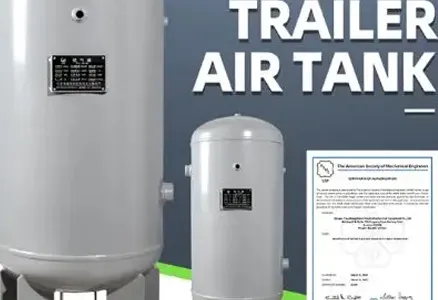
The Change in Installation Orientation Affects the Layout, Not the Basic Air Storage Function
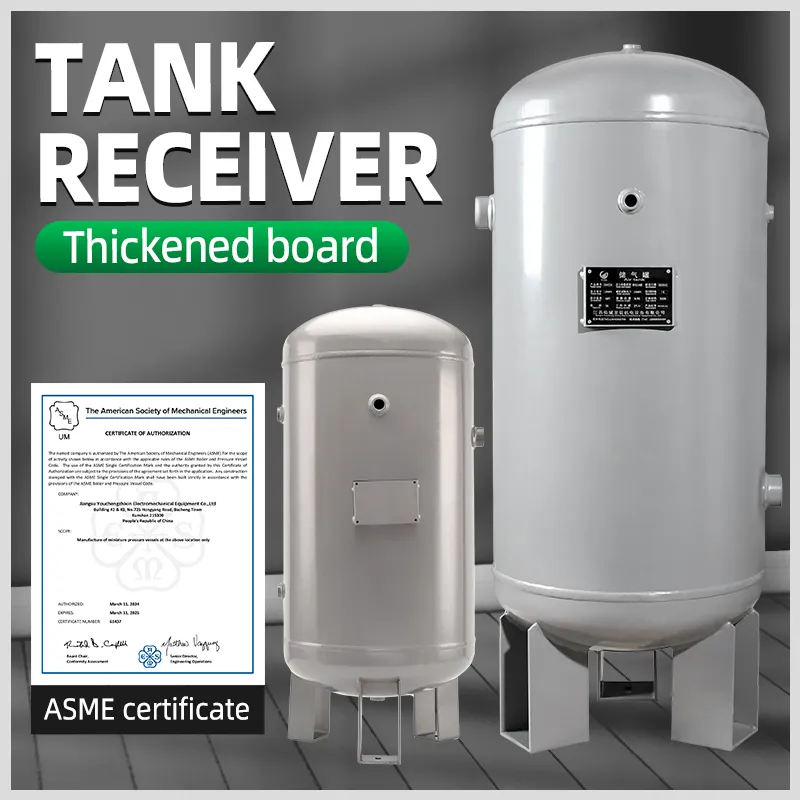
Both vertical and horizontal air receiver tanks are used to store compressed air and stabilize system pressure. The choice usually depends on space, drainage, maintenance, transportation, and equipment integration, rather than any fundamental difference in their basic air storage performance.
When floor space is limited, vertical air receiver tanks are often more advantageous; when installation height is restricted, or when the air receiver tank needs to be integrated below the compressor unit, a horizontal structure might be more suitable.
In What Situations is the Vertical Structure More Advantageous?
Under the same volume conditions, vertical air receiver tanks usually take up less floor space, making them suitable for compact compressor rooms or production areas with dense equipment. If the container and drainage device are properly designed, the bottom connection also facilitates the discharge of condensate.
When pipelines connect from above, or when the purchaser wants to place the air receiver tank next to the compressor skid rather than below it, a vertical layout may also offer a clearer arrangement.
In What Situations is the Horizontal Structure More Suitable?
Horizontal air receiver tanks can be used under compressor units, trailers, mobile equipment, or in low-height areas. Their lower center of gravity might be beneficial for certain transportation and installation methods, but support and anchoring still require engineering evaluation.
When the air receiver tank is elevated by saddles, the interface and drainage operations may be more convenient, but it must be ensured that the lowest point can be fully drained and there is space for maintenance.
Main Installation Differences
Factors | Vertical Air Receiver Tank | Horizontal Air Receiver Tank |
Floor Space | Usually smaller | Usually larger |
Height Requirements | Higher | Lower |
Common Support | Legs, skirt, or base structure | Saddle, legs, or frame |
Drainage Position | Usually at the bottom center | At the lowest point arranged on the shell or end |
OEM Integration | Beside equipment or within vertical space | Below equipment or along the frame |
Transportation Considerations | Height and anti-overturn stability | Length and support spacing |
Maintenance Space | Focus on top interface and climbing operations | Focus on the area around the saddle and bottom drainage space |
Five Questions Before Determining Installation Orientation
1. What is the available floor space and ceiling height on site?
2. How are the intake, outlet, safety valve, pressure gauge, and drainage interfaces arranged?
3. How will the air receiver tank be anchored, lifted, and transported?
4. Can operators safely drain and inspect the container?
5. Is the air receiver tank installed independently, or integrated into an OEM frame?
Drainage and Condensate Control
The installation orientation cannot replace condensate management. The drainage port must be at the true lowest point and leave space for maintenance or automatic drain replacement. The pipeline should not form low points prone to water accumulation.
A vertically arranged tank with unreasonable drainage layout might not be as effective as a properly designed horizontal tank. Installation details are more important than the "vertical" or "horizontal" label.
Foundation, Support, and Pipeline Load
Vertical air receiver tanks require a stable foundation and proper anchoring, especially where there are vibration, transportation impact, wind load, or seismic requirements. Horizontal air receiver tanks require saddles and support spacing that match the container design.
The air tank manufacturer should receive information on the installation structure, pipeline direction, and external loads, and should not forcefully pull the interface to the corresponding position through rigid pipelines.
How to Write Specification Requirements?
Provide capacity, pressure, temperature, material, available floor space, maximum height, interface layout, drainage method, foundation, or frame information and the target market. If the air receiver tank is to be installed inside equipment, provide 3D or assembly layouts.
YCZX can provide vertical air receiver tanks, horizontal air receiver tanks, and custom configurations. The final orientation should be confirmed along with safety accessories, maintenance space, and compliance requirements.
Frequently Asked Questions
Can a vertical tank store more air under the same volume?
No. The installation orientation does not change the nominal internal volume.
Is it always easier to drain a vertical tank?
It can achieve effective bottom drainage, but the lowest point, drainage interface, and installation method must be correctly designed.
Which orientation is more suitable for OEM compressor units?
It depends on the equipment envelope. Horizontal tanks are often used below the frame, while vertical tanks can reduce the footprint beside equipment.
Conclusion
When floor space is the primary constraint, and the site can meet height, anchoring, and maintenance requirements, a vertical option can be prioritized; when ceiling height is limited, or the air receiver tank needs to be installed below equipment or along the frame, a horizontal option can be chosen. Before confirming the drawings, drainage, support, and maintenance space should be checked simultaneously.