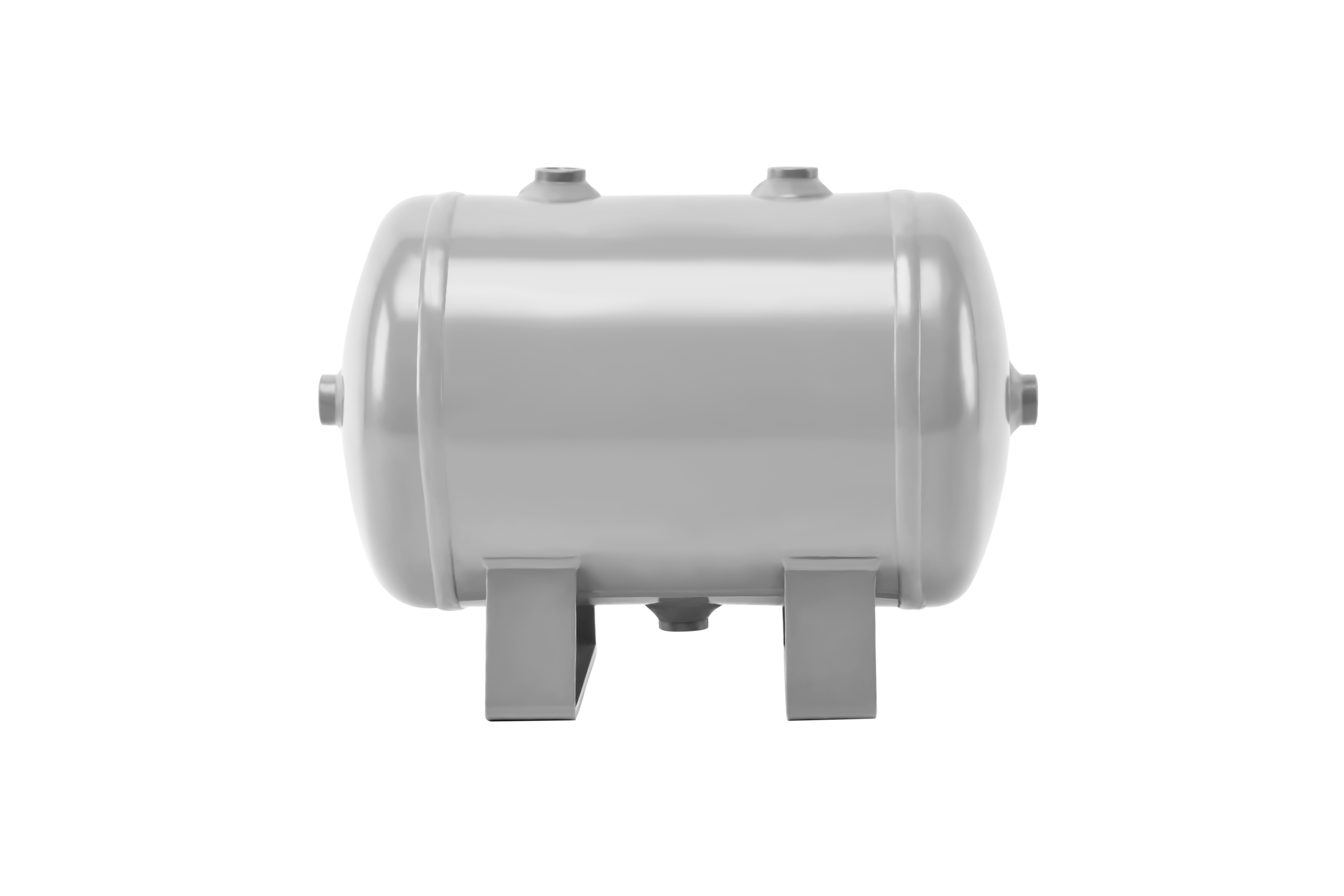
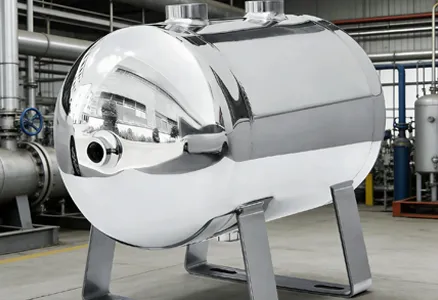
After carbon steel air receivers are welded, shot blasting is an essential core pretreatment procedure prior to powder coating anti-corrosion treatment. It directly determines the anti-corrosion service life, coating adhesion and structural service life of the air tank. Standard and complete shot blasting can simultaneously remove rust and scale, release welding stress, and form anchor patterns for coating. Below is a detailed introduction to the core functions and standard technological process of shot blasting for air receivers.
Core Functions of Shot Blasting for Air Receivers
1. Complete Removal of Rust and Impurities
High-speed steel shots impact the tank surface to thoroughly eliminate loose rust, mill scale, welding slag and residual oil stains on the base metal, revealing a uniform metallic finish. This prevents coating peeling, blistering and shedding caused by residual rust layers in later service.
2. Release Residual Welding Stress and Improve Tank Durability
Plate rolling and welding of the air tank generate concentrated tensile stress, which tends to produce microcracks under long-term pressure. The impact of shot blasting forms uniform residual compressive stress on the steel surface to counteract alternating pressure and restrain crack propagation. It greatly extends the pressure fatigue life of air receivers and reduces risks of corrosion cracking.
3. Form Anchor Patterns to Greatly Boost Powder Coating Adhesion
Shot blasting creates uniform fine uneven roughness on the tank surface to form an "anchor pattern" structure, enabling electrostatic powder to firmly grip the steel substrate. Compared with simple grinding, coating adhesion is multiplied, and the coating resists peeling and fading even in humid outdoor environments.
4. Beautify Surface and Cover Minor Processing Defects
Uniform impact of steel shots softens uneven weld beads and slight grinding marks for a consistent surface texture, delivering smoother and more attractive finished appearance after subsequent smooth or orange peel powder coating. It also removes edge burrs and sharp corners.
5. Eco-friendly Physical Process with Zero Pollution
Only recyclable steel shots are used throughout the process without pickling chemicals. No wastewater or corrosive waste liquid is discharged, complying with environmental production standards for pressure vessels. It is suitable for manufacturing air receivers applied in food, pharmaceutical and other industries.
Complete Standard Shot Blasting Process for Air Receivers
1. Pre-treatment Masking
Seal all threaded holes, flange sealing surfaces and pressure gauge connectors of the tank to avoid steel shot blockage of threads. Seal the inner cavity of the tank; shot blasting is only carried out on the outer wall to prevent hard-to-clean steel shots from entering the tank interior.
2. Loading and Positioning
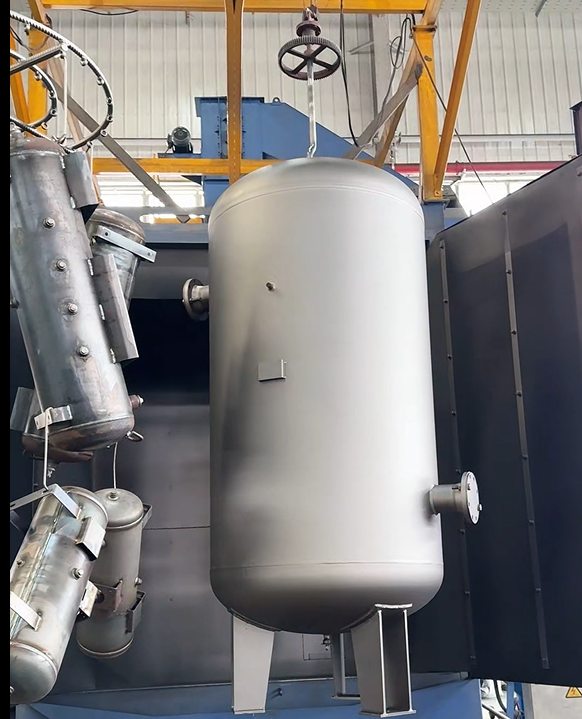
Hoist fully welded and roughly ground air receivers into an enclosed shot blasting chamber, fixed by tooling to ensure steady rotation of the tank. This achieves full-coverage treatment without dead angles on heads, tank bodies and supports.
3. Closed-loop Shot Blasting Operation
Multiple shot blasters eject steel shots at high speed while the tank rotates slowly, allowing uniform bombardment on the entire outer surface. Steel shots falling to the bottom are automatically recycled via lifting, screening and dust removal systems, with dust filtered and discharged centrally.
4. Air Purge for Shot Removal
After shot blasting, high-pressure dry air fully blows the tank surface to clear residual steel shots and dust in gaps and blind spots, ensuring a clean substrate free of foreign matter.
5. Quality Inspection
Inspect the rust removal grade, surface roughness, missing blasting areas and pits from over-blasting. Confirm full rust removal across welds, heads and supports. Once the roughness meets standards, transfer the tank immediately to the electrostatic powder coating process to avoid secondary rust formation.
Key Process Quality Control Points
l Rust removal standard: Strictly comply with Sa2.5 grade; no visible rust or mill scale, only a tiny amount of scattered minor residues is permitted.
l Roughness control: Ra 40–75 μm. Insufficient roughness leads to poor adhesion, while excessive roughness increases powder consumption.
l Time limit control: Complete powder coating within 4 hours after shot blasting; shorten the time limit to 2 hours in humid environments to prevent steel rusting.
Shot blasting is the fundamental procedure for long-term anti-corrosion performance of air receivers. Omitting or simplifying this process will drastically shorten tank service life and raise subsequent maintenance costs. As a professional air receiver tank manufacturer, YCZX is equipped with fully automatic enclosed dedicated shot blasting production lines for air receivers, implementing standardized full-process control over rust removal, stress relief and anchor pattern formation. We provide complete matching processing for smooth and orange peel powder coatings, and customize air receivers for indoor, outdoor and clean workshop scenarios as required. If you have demands for purchasing or customizing air receivers, please share your working conditions and anti-corrosion requirements, and we will provide integrated mature manufacturing solutions.