Every air receiver tank that leaves a reputable factory has been filled with water and pressurized before it is painted, packed or shipped. This is the hydrostatic test, and it is the single most important verification step in the entire production process. It is not a formality added for paperwork, and it is not a substitute for careful design — it is the physical proof that the vessel as built can carry the pressure it claims. Understanding why it is done, how it is done, and what it actually proves explains why buyers should treat a test report as a core part of the purchase, not an optional attachment.
1. What the Test Actually Does
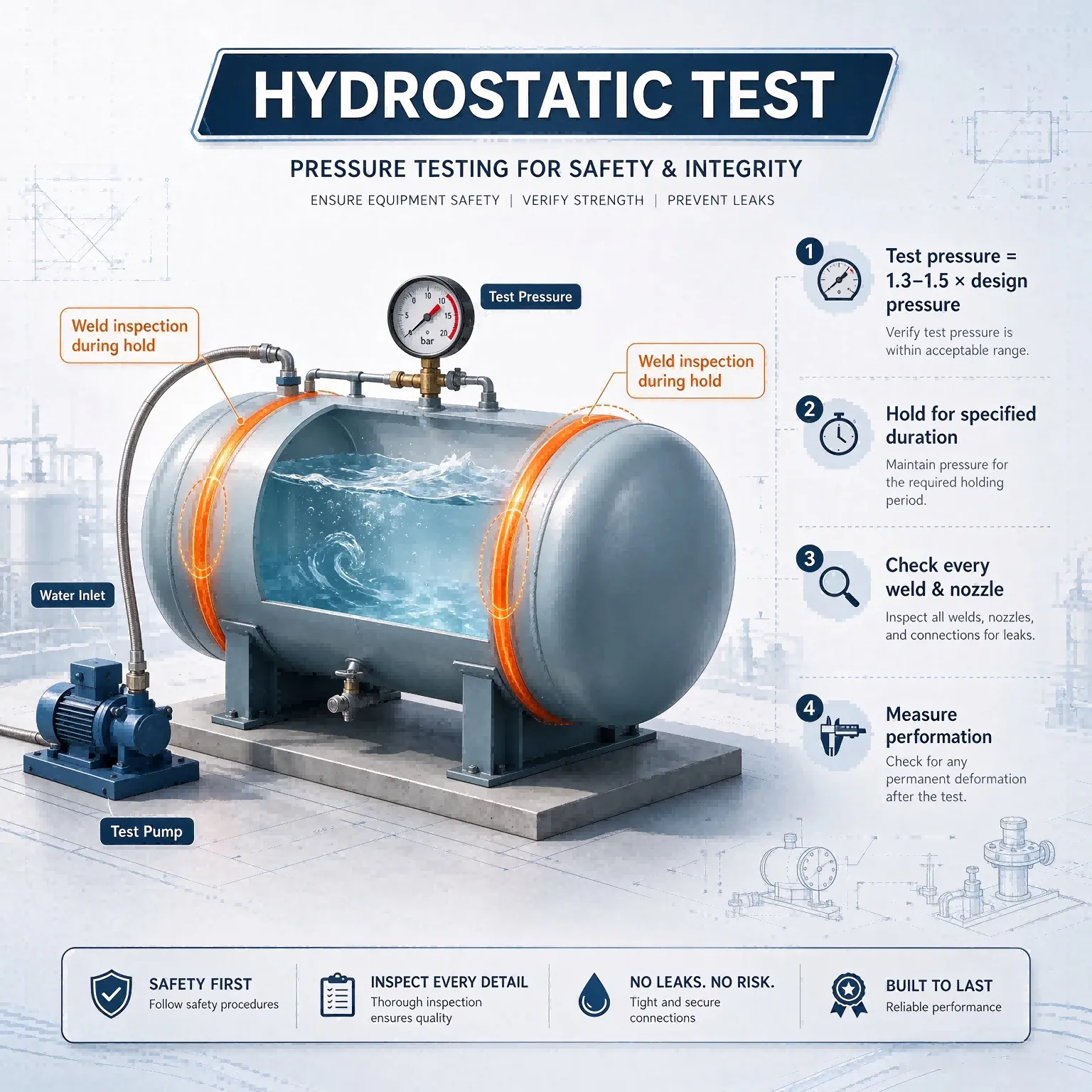
A hydrostatic test fills the completed vessel with water, pressurizes it to a specified test pressure above the design pressure, holds it for a defined period, and then inspects the entire surface for leakage, distortion and permanent deformation.
Its purpose is verification, not proof of design. The design calculations determine the wall thickness on paper; the hydrostatic test confirms that the actual vessel — the plate that was rolled, the welds that were made, the nozzles that were fitted — behaves as the calculation predicted. Any gap between the two shows up here.
2. Reason One: Verifying Structural Strength
The primary function is to demonstrate that the vessel can withstand pressure beyond its normal operating condition without permanent deformation.
The test pressure is deliberately set above design pressure, typically in the range of 1.3 to 1.5 times design pressure depending on the applicable code, and held long enough to reveal weakness rather than just to touch the limit. If a weld is under-strength, if the plate is thinner than specified, or if a nozzle reinforcement is insufficient, the vessel will show it — through visible bulging, through measurable permanent deformation after the pressure is released, or through failure.
This margin matters in service. A tank that has passed a test above design pressure has demonstrated reserve capacity for transient pressure spikes, control failures and temperature-driven pressure rise that occur in real systems.
3. Reason Two: Proving Weld Tightness
The second function is leak detection, and it is the one most often associated with the test in practice.
A receiver is a welded assembly: longitudinal seams, circumferential seams, nozzle-to-shell connections, head-to-shell joints. Each of these is a potential leak path. Radiography and other non-destructive testing sample and inspect weld quality, but they cannot prove that the whole assembly is gas-tight at pressure. Only pressurization does that.
During the hold period, every weld, every nozzle and every joint is inspected. Water is an excellent tracer: a pinhole leak through a weld shows immediately as a droplet or a wet trace, whereas the same defect in a compressed-air test might be inaudible or invisible. This is why the test is done with water rather than air.
4. Reason Three: Why Water, Not Air
The choice of water as the test medium is a safety decision, and it deserves explanation because it is frequently misunderstood.
Water is essentially incompressible. Air is highly compressible and stores enormous energy. If a vessel ruptures during an air test, the stored compressed energy is released in an explosion — the classic "pneumatic test accident" in which the vessel fails catastrophically and fragments travel a long distance. If the same vessel fails during a water test, the water releases almost no stored energy: the pressure drops immediately and the failure is a crack or a small leak rather than an explosion.
That is the entire reason hydrostatic testing is mandatory and pneumatic testing is restricted to special cases with heavy precautions. Water protects the people running the test.
5. Reason Four: Detecting Permanent Deformation
Beyond leakage, the test checks whether the vessel has been permanently altered by pressure.
Measurement is taken before pressurization, during the hold and after depressurization. If the vessel returns to its original dimensions, the deformation was elastic, which is the expected result. If it does not return, the vessel has yielded — meaning the material was stressed beyond its elastic limit at some point, and the vessel's integrity is compromised even though no leak appeared. A tank that shows permanent deformation does not ship.
This check is what separates a real test from a pressure-holding exercise. Holding pressure without measuring deformation proves tightness but not structural soundness.
6. Reason Five: Compliance and Traceability
The hydrostatic test is a code requirement, not a manufacturer's option. Vessels built to ASME carry a test requirement tied to the U Stamp; vessels built to PED carry the equivalent requirement under 2014/68/EU; domestic vessels follow the applicable pressure-vessel code. A tank that has not been tested cannot legally carry the marking.
The test also produces a record — test pressure, hold duration, ambient and water temperature, inspector, result — that becomes part of the technical file. That record is what a customs officer, a notified body auditor or an end-user's safety inspector actually checks. It is the evidence that the claim of pressure capacity is not just a number on a nameplate.
7. Reason Six: It Happens Before Painting, on Purpose
The sequence in production is deliberate: welding, non-destructive testing, hydrostatic test, then surface preparation and painting.
Testing before painting means any weld that needs repair is repaired on bare metal, and the repair itself is re-tested. Testing after painting would mean a leak discovered afterwards requires stripping the coating, re-welding, re-testing and re-coating — more expensive, and tempting to skip. Correct sequence protects both quality and cost.
8. How YCZX Runs the Test
YCZX performs a hydrostatic test on every individual tank, not on a sample basis. The test pressure is set from the design pressure under the applicable code; the vessel is filled, vented completely, pressurized in stages, held for the specified duration, and inspected across all welds and nozzles. Deformation measurements are taken and compared before and after. The test report is recorded and shipped with the technical file alongside material certificates and nameplate data.
After testing, the tank is drained, dried internally and the interior is treated for rust protection before painting, so the water used for testing does not become a corrosion source in service. For export orders built to ASME or PED, the test records are formatted to match what the destination market's inspector expects to see.
Conclusion
The hydrostatic test exists for one reason: to prove, physically and on the actual vessel, that the tank can carry its rated pressure and does not leak. It verifies structural strength beyond operating conditions, proves weld tightness, uses water instead of air to protect the people performing it, detects permanent deformation that pressure-holding alone would miss, satisfies the code that permits the marking, and produces the record that buyers and inspectors rely on. A test report is not paperwork attached to a tank — it is the evidence that the tank is what it claims to be.