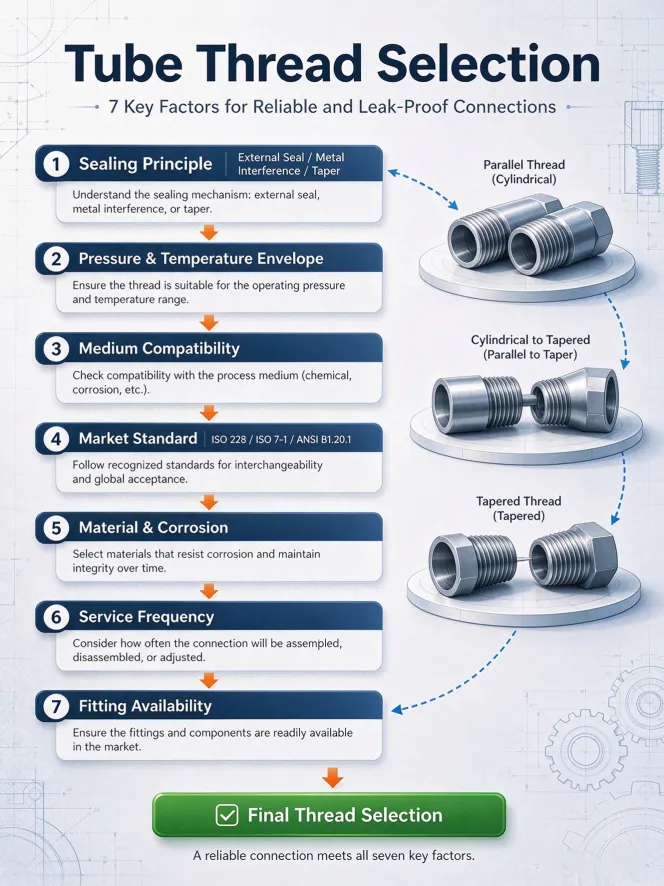
Pipe threads look like a commodity detail, but in engineering they are a decision with consequences. A thread chosen for the wrong reason does not fail spectacularly — it leaks slowly, works loose under vibration, strips at the port, or arrives at a site where no matching fitting exists. Selecting a thread properly means working through a set of factors in a fixed order: how the thread seals, what pressure and temperature it will see, what medium flows through it, which standard the market expects, what material it sits in, how often it will be opened, and whether the matching fittings are actually available. This article works through those factors in the order they should be considered.
1. Sealing Principle: The First Question, Not the Last
The first factor is how the thread achieves sealing, because that determines everything else.
A parallel non-sealing thread (G, to ISO 228-1) does not seal through its flanks. It holds the joint together and relies on an external element — a face gasket, an O-ring, PTFE tape or sealant. It is simple, cheap and easy to assemble, and it suits low-pressure, easily maintained joints. But it has no self-sealing ability, so it loosens under pulsation and leaks once the external seal ages.
A sealing thread family (Rp/Rc to ISO 7-1) seals by metal interference: Rp, a parallel internal thread, mates with R1, an external taper, for a parallel-taper seal with sealant; Rc, a taper internal thread, mates with R2, an external taper, for a taper-taper metal-to-metal seal. This family is designed for medium-to-high pressure and vibration.
A taper sealing thread (NPT to ANSI B1.20.1) seals by its own 1:16 taper, with metal-to-metal interference and sealant at higher pressure. It is the default in the North American market.
The engineering point is that these are three different failure modes, not three cosmetic variants of the same thing. Deciding the sealing principle first — external seal, matched metal interference, or self-sealing taper — narrows the selection immediately. At YCZX the port thread is set from this question before anything else is specified, because a tank that seals the wrong way cannot be corrected later by better fittings.
2. Pressure and Temperature: The Envelope
Once the sealing principle is fixed, pressure decides the thread's practical limit. A G thread belongs below roughly 1.6 MPa; above that, the external seal cannot be relied on and a sealing thread or flange is required. Rp/Rc covers medium-to-high pressure comfortably. NPT seals well from low pressure up to high-pressure hydraulics, with sealant at the top end.
Temperature matters just as much, because threads are sealed by gaskets, tapes and sealants, and those materials have temperature limits. A joint that seals at ambient can harden, crack or flow at high temperature, and become brittle at low temperature. The thread type and the sealing material must both be rated for the service temperature, not just for the pressure.
3. Medium: What Flows Through, and What It Does to the Joint
The medium sets both corrosion requirements and sealing requirements. Compressed air is mild but carries water and oil; water and coolant promote corrosion; fuel gas demands a joint that will not leak under any circumstance; chemicals may attack both the thread material and the sealant.
Two practical consequences follow. First, the thread material must suit the medium — carbon steel for air and water, brass or stainless for corrosive or clean-duty service. Second, some media rule out certain sealing approaches entirely: solvent or oxygen service may prohibit tape residue, and fuel gas may require a specific approved sealant rather than a generic one. Selecting a thread without checking what flows through it is how joints pass factory testing and fail in the field.
4. Market Standard: What the Buyer Expects to See
A thread is also a convention. Europe and much of the world expect G and Rp/Rc to ISO standards; North America expects NPT to ANSI B1.20.1. A tank built to the correct pressure rating but threaded to the wrong convention is effectively unusable — the site cannot connect it, or connects it once and damages both threads.
This is a market question, not a preference. It is also the factor customers most often leave out of an inquiry. At YCZX the target market is confirmed before the port thread is set: G for European and general markets, Rp/Rc where the customer's system follows the BSP sealing convention, and NPT for North American packages. Product that matches the market is product that can be installed.
5. Material and Corrosion: The Thread Is Part of the Vessel
Threads are cut into the tank wall or into a welded nozzle, so they are part of the pressure boundary. The thread material must match the vessel material and the medium: a stainless tank does not take a carbon steel nozzle without a corrosion couple, and a brass fitting in a stainless port creates its own issues over time.
Corrosion allowance matters here too, because a thread cut into a wall removes material, and long-term service reduces wall thickness further. Ports that will be opened repeatedly — drains, gauge connections — see more mechanical wear than ports set once and forgotten. At YCZX the nozzle material and wall thickness at the port are checked against the vessel and the medium, not treated as a separate small part.
6. Service and Maintenance: How Often It Will Be Opened
The number of times a joint is opened changes which thread is acceptable. A drain port opened every shift needs a thread and seal that tolerate repeated assembly without damage; a gauge port set once at commissioning can use a more permanent joint. Parallel threads with replaceable tape or gaskets are easier to service repeatedly than taper threads, which wear each time they are remade.
This factor also decides how much to invest in a port. Spending on a high-grade taper thread at a point that will be re-taped weekly is wasted; putting a low-cost parallel thread on a joint that must hold for years under vibration is a false saving.
7. Availability of Matching Fittings
The last factor is the one that decides whether the design survives contact with the site: are the matching fittings available? A thread standard with no local supply of fittings, adapters or sealants becomes a maintenance problem regardless of how correct it is on paper. Taper-taper pairs need both halves present; a tank with Rp ports and no R1 fittings in the region is a tank waiting for an adapter.
YCZX addresses this by shipping a thread pairing note with Rp/Rc orders, so the site knows exactly which external thread belongs with each port, and by fitting protective caps to every port so the thread arrives undamaged and does not need re-cutting. Where a customer's site piping standard differs from the market norm, we raise it before production rather than after the tank lands.
Conclusion
Selecting a pipe thread is a sequence: sealing principle first, then pressure and temperature envelope, then medium, then market standard, then material and corrosion, then service frequency, and finally fitting availability. Each factor eliminates options, and skipping one is how a joint ends up correct on paper and wrong on site. When the thread is treated as part of the specification from the start — as YCZX does — the result is a port that connects, seals and stays serviceable for the life of the vessel.