When an air receiver tank is sized, dozens of details could be discussed — material, ports, support type, coating, certification. But if the two fundamental parameters are wrong, none of the rest will compensate. Those two parameters are volume (capacity) and working pressure (which determines design pressure). Volume decides whether the tank can buffer your demand; pressure decides whether it can carry your operating condition safely. Get both right, and the receiver becomes a reliable part of the system. Get either wrong, and you either pay for capacity you never use, or you operate a vessel outside its safe envelope.
1. Parameter One: Volume — How Much Air You Actually Need to Store
Volume is the most visible specification and the one most often chosen by habit. It determines how much compressed air the tank holds as reserve, how well it absorbs demand spikes, and how often the compressor cycles.
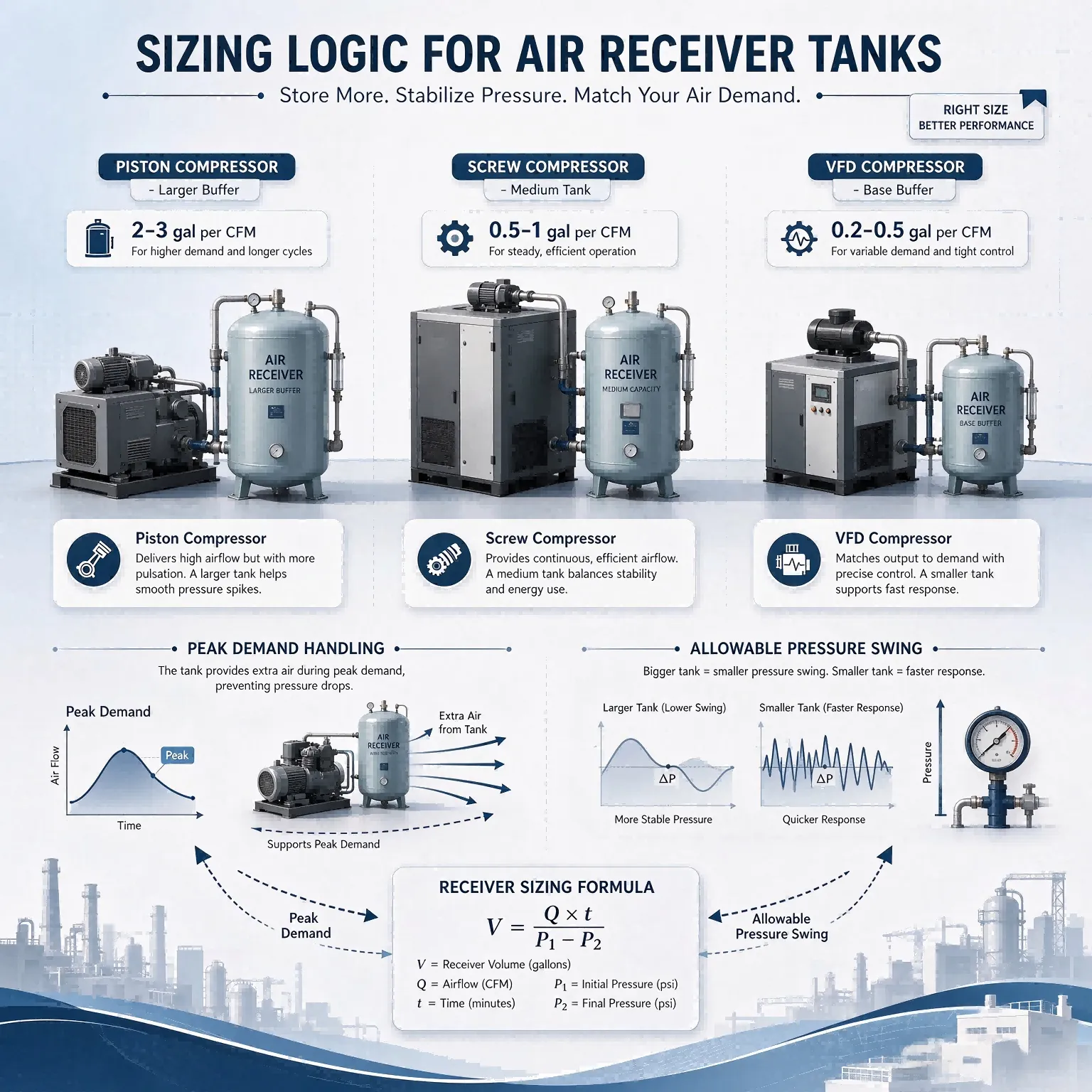
Volume should not be selected from the compressor nameplate alone. The number that matters is the relationship between compressor output and actual demand. Three inputs drive the calculation.
First, compressor displacement — the CFM or m³/min the compressor delivers. A piston compressor delivers pulsating flow and needs a relatively larger buffer; a screw compressor delivers continuous flow and needs less; a VFD compressor follows demand by varying speed and needs only a base buffer volume.
Second, the demand curve — average versus peak consumption. A workshop with continuous low flow needs only enough volume to smooth minor fluctuations. A workshop with intermittent peaks — batch cylinder actuation, blow-down, spray operations — needs volume sized around the worst-case peak, because that peak is what drains the tank and triggers compressor cycling.
Third, the allowable pressure swing — how much pressure variation the process tolerates. Precision equipment may require pressure held within a narrow band; a general workshop tolerates a wider swing. A tighter band requires a larger tank for the same demand.
The practical consequence is that the same compressor can justify very different tank volumes depending on how it is used. Sizing by "one size up from the last project" is how systems end up with tanks that are either idle most of the day or too small to stop the compressor from short-cycling.
There is a real cost to oversizing as well. A larger tank takes longer to pressurize from cold, so the compressor runs loaded longer before any air reaches the process, and that fill energy repeats at every startup. A larger tank also means more footprint, a heavier foundation and more condensate to manage. Volume should be matched, not maximized.
At YCZX, volume is never quoted from the compressor nameplate alone. On each inquiry we collect compressor type and displacement, the demand curve and its peaks, and the allowable pressure swing, then calculate the buffer volume against those actual conditions. When a customer's existing receiver turns out to be oversized, we say so and recommend a matched size — because a tank that is idle most of the day is not a safer tank, it is just a more expensive one.
2. Parameter Two: Working Pressure — and the Design Pressure Behind It
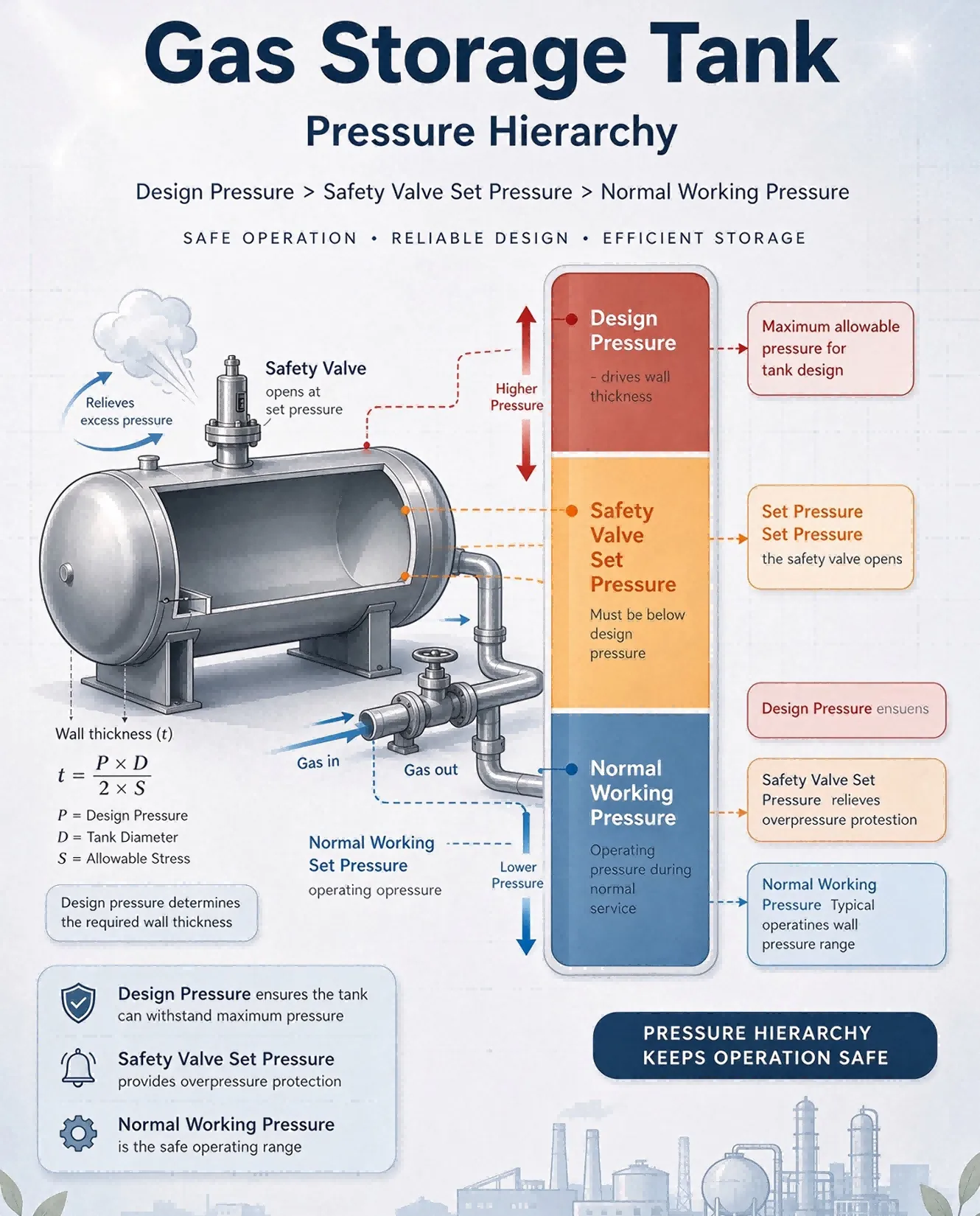
The second parameter is the pressure the tank will actually see in service. This matters because pressure, not volume, determines wall thickness, material grade and the safety envelope.
Working pressure is the normal operating pressure of the system. But a receiver is not designed to working pressure alone — it is designed to a design pressure above the highest pressure the system can produce, so transient spikes, control failure or temperature rise cannot push the vessel past its limit. Design pressure then drives wall thickness together with diameter, material strength, corrosion allowance and weld joint efficiency.
This has three practical consequences.
First, design pressure must be set from the worst case, not the average. If the compressor can produce more than the normal working point, or the tank sits where ambient temperature can raise internal pressure, design pressure must cover that.
Second, the safety valve set pressure must be coordinated with the design pressure. The valve opens below design pressure but above working pressure, protecting the vessel without lifting in normal operation. A tank and a safety valve specified independently by different parties is a common source of nuisance lifting or inadequate protection.
Third, pressure determines the compliance path. Pressure, volume and medium together decide the pressure-vessel category, and therefore whether a notified body is involved, what inspection applies, and which documentation ships with the tank.
YCZX sets design pressure from the maximum pressure the system can produce, not from the nominal working point, then derives wall thickness and material grade under the applicable code. Safety valve capacity and set pressure are matched to the same design pressure, and gauge ranges are chosen so normal working pressure sits in the readable middle band. That way the relief protection, the readout and the vessel all agree on the same pressure basis — instead of the tank being specified by one party and its safety valve by another.
3. Why the Two Parameters Must Be Considered Together
Volume and pressure are not independent choices. Together they drive wall thickness, port sizing, support design and cost, and together they define the pressure-vessel category. A large tank at low pressure and a small tank at high pressure can land in completely different categories, with different inspection and documentation requirements. Selecting volume first and pressure second, or treating one as fixed, usually leads to a tank that is either over-built and expensive or under-built and non-compliant.
Because the two parameters interact, YCZX evaluates them in one pass rather than as separate line items. The same review determines whether the unit falls under a simple-vessel path or a conventional fixed-vessel path, and for North American and European projects whether ASME or PED applies. Tank, ports, accessories and documentation are then all built against that single calculated basis, so the wall thickness, the safety valve and the nameplate never contradict each other.
4. What Gets Built Once the Two Parameters Are Fixed
Once volume and pressure are settled, the rest of the specification follows logically rather than by guesswork. Wall thickness comes from design pressure, diameter, material and corrosion allowance. Ports follow the target-market thread standard — G for Europe, NPT for North America — and each ships with a protective cap. Supports are chosen for the tank's height-to-diameter ratio and installation conditions. Coatings are selected for the medium and environment, and every unit receives a hydrostatic test with records retained.
At YCZX this sequence is standard rather than case-by-case improvisation: the two parameters are confirmed, the code basis is set, and then material, thickness, ports, supports, coating and documentation are derived from that basis and recorded in the technical file.
Conclusion
Volume and working pressure are the two parameters that decide whether a receiver tank fits its system. Volume must be matched to compressor output, demand peaks and allowable pressure swing — not maximized out of habit. Working pressure must be translated into a design pressure that covers the worst case, then carried through wall thickness, safety valve setting and the compliance path. When one manufacturer owns both the calculation and the build, the tank, its accessories and its paperwork all come from the same basis — and that is what makes the receiver correct for the job rather than merely compliant on paper.