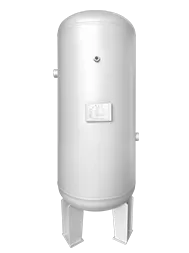
Air receivers, commonly known as compressed-air storage tanks, are fundamental components in every compressed-air system. They stabilize pressure fluctuations, store reserve gas for peak demand, separate condensed water and provide a buffer between air compressors and end‑use pneumatic equipment. Across industries, air receivers are manufactured in a wide range of sizes and pressure ratings. However, not every vessel can serve every application. A tank rated for a low‑pressure workshop circuit cannot simply be used in a high‑pressure gas system — the pressure rating determines the wall thickness, material grade, head geometry, test requirements and applicable safety codes of the vessel.
This is why classifying air receivers by working pressure is one of the most important steps in equipment selection. Misjudging the required pressure class can lead to vessel over‑design and wasted cost, or — far worse — under‑design that creates serious safety hazards. As a professional pressure vessel manufacturer, YCZX classifies its custom air receivers into 3 main pressure classes and applies rigorous engineering and quality‑control procedures for each.
Low‑Pressure Air Receivers (0.1–1.6 MPa)
The first category covers low‑pressure air receivers operating at roughly 0.1 to 1.6 MPa. This range is by far the most common in general industrial manufacturing. Typical applications include general compressed‑air networks in machinery workshops, assembly lines, packaging plants, textile factories, small food-processing facilities and other ordinary production environments where standard pneumatic tools and actuators operate.
Low‑pressure air receivers are generally fabricated from carbon‑steel plates of moderate thickness. Because the internal pressure is relatively modest, the required shell wall thickness is usually small, which keeps the vessel lightweight, cost‑effective and easy to install. Common material choices include Q235B, Q355B and pressure‑vessel‑specific grades such as Q345R. The dished heads are typically standard elliptical heads. Design and fabrication normally follow GB150 for domestic projects and ASME Section VIII Div.1 for export markets.
Although the pressure is low, quality control at YCZX remains uncompromising. Every low‑pressure tank starts with strict incoming raw‑material inspection, verifying mill certificates and material traceability. Shells are formed through controlled plate rolling to maintain roundness and weld‑gap accuracy. Girth seams are welded with standardized parameters, followed by non‑destructive examination where required. Each finished low‑pressure receiver must pass a hydrostatic pressure test conducted at a pressure level specified by the design code. We understand that even in a 1.0 MPa workshop circuit, a defective weld can cause leakage, production shutdown or personal injury. Therefore, low pressure never means low standards at YCZX.
Medium‑Pressure Air Receivers (1.6–10.0 MPa)
The second category comprises medium‑pressure air receivers rated from approximately 1.6 to 10.0 MPa. These vessels are used in applications demanding higher pneumatic force or specific industrial processes. Common scenarios include high‑pressure pneumatic equipment in heavy manufacturing, die-casting and stamping stations, hydropneumatic energy storage, gas‑boosting buffer systems and certain chemical or instrumentation circuits where higher delivery pressure is required.
Compared with low‑pressure tanks, medium‑pressure receivers demand substantially thicker shells, higher‑strength steel plates and more careful head and nozzle design. The engineering calculation of wall thickness, nozzle reinforcement and head thickness must follow pressure‑vessel design codes precisely. Welding becomes far more demanding because thick plates increase the risk of incomplete fusion, slag inclusion and residual stress concentration. At YCZX, our welders hold valid qualification certificates, and every welding procedure is validated through formal Welding Procedure Qualification Records before production begins. Heat input, inter‑pass temperature and post‑weld treatment are tightly controlled.
Quality verification for medium‑pressure vessels is especially rigorous. In addition to visual inspection, critical welds undergo non‑destructive examination, including penetrant testing and radiographic testing, to detect subsurface defects invisible to the naked eye. Every medium‑pressure receiver is subjected to a mandatory hydrostatic test, often combined with pneumatic leak testing to confirm sealing performance of nozzles and threaded interfaces. Material certificates, welding records, NDT reports and test documentation are compiled into a complete traceable dossier supplied with each shipment. This disciplined process guarantees that a 6.0 MPa or 8.0 MPa vessel performs safely and reliably throughout its service life.
High‑Pressure Air Receivers (above 10.0 MPa)
The third category covers high‑pressure air receivers with working pressures above 10.0 MPa. These specialized vessels serve demanding fields such as high‑pressure gas storage, high‑pressure gas boosting systems, special industrial gas applications and certain research or energy-related projects. High‑pressure vessels carry significantly higher stored energy, so design margin, material performance and fabrication precision become critical factors.
High‑pressure receivers generally require thick high‑strength steel plates, forged or specially formed heads, and carefully reinforced nozzles. The design must account not only for static internal pressure but also for fatigue loading caused by repeated pressure cycling. Wall‑thickness calculations, nozzle‑opening reinforcement and material toughness selection all require advanced engineering analysis. At YCZX, high‑pressure custom projects are supported by our engineering team, who evaluate operating pressure, temperature, medium properties and cycling frequency before recommending the appropriate material grade and structural design.
Fabrication of high‑pressure vessels demands the highest level of discipline. Plate rolling must achieve precise roundness; assembly gaps must be strictly controlled; and welding parameters must be executed exactly as specified in the approved WPS. Non‑destructive examination of high‑pressure welds is comprehensive, and hydrostatic testing is performed at elevated test pressures mandated by the applicable code. Because even minor hidden flaws can grow into serious defects under high pressure and cyclic loading, our quality gates are applied at every manufacturing stage — never relying solely on final inspection to catch problems. YCZX treats every high‑pressure vessel as a critical safety product requiring the utmost care.
YCZX Quality Control Across All Pressure Classes
Regardless of pressure class, YCZX applies the same philosophy: quality is built into every process, not merely checked at the end. Our manufacturing system embeds multiple quality gates throughout the entire workflow.
Raw‑material management is the first gate. Every steel plate — whether carbon steel or stainless steel — is verified against mill test certificates upon arrival. Unauthorized material substitution is strictly prohibited, and full traceability is maintained from incoming plate to finished vessel.
Fabrication discipline forms the second gate. Plate cutting, rolling, shell-and-head assembly, tack-welding, automatic girth-seam welding, nozzle welding and support-bracket welding all follow documented work instructions. Standardized parameters, controlled heat input and proper welding consumables ensure repeatable, consistent weld quality across batches — whether the vessel is a low-pressure workshop tank or a high-pressure specialized receiver.
Testing and documentation represent the final gate. Visual inspection, non-destructive examination, hydrostatic pressure testing and pneumatic leak testing are executed according to code requirements. Defective workpieces are segregated and reworked before re-inspection. Each custom receiver is delivered with complete process documentation, satisfying domestic GB150 requirements and international ASME Section VIII Div.1 specifications, and supporting clients' local acceptance and regulatory filing.
Classifying air receivers by working pressure is not merely a technical convention; it is the foundation of safe equipment selection. Low-pressure receivers from 0.1 to 1.6 MPa serve general industrial production, medium-pressure receivers from 1.6 to 10.0 MPa handle higher-pressure industrial processes, and high-pressure receivers above 10.0 MPa support specialized high-pressure applications. Each class demands different materials, wall thicknesses, head geometry, welding procedures and testing rigor.
At YCZX, our experience as a professional pressure-vessel manufacturer spans all three pressure classes. We combine mature engineering capability, standardized in-house fabrication processes, strict raw-material management and comprehensive multi-stage testing to deliver safe, durable, code-compliant air receivers. Whether you need a standard low-pressure workshop tank, a heavy-duty medium-pressure receiver or a specialized high-pressure vessel for unique operating conditions, YCZX provides a tailor-made solution backed by full-process quality control.
Choosing the right pressure class protects your equipment, your production continuity and, above all, your personnel. Partner with YCZX for your next custom air receiver project — we bring the experience, discipline and quality assurance to build the right vessel for the right application.