Two drawings land on the same desk, both showing a cylindrical steel shell with a manway, a drain and two pipe stubs. One is quoted at 3,200 USD, the other at 9,800 USD, and the supplier keeps saying they are basically the same thing. They are not. The difference between pressure vessel and storage tank decides which design code applies, who signs the paperwork, which test the shell must survive, and whether the equipment may be installed at all without a re-inspection order. This guide covers four places where the two diverge: the pressure the shell is built for, how that pressure reshapes the structure, the thickness and head geometry that follow, and the testing trail a buyer may demand before paying.
What Is the Difference Between Pressure Vessel and Storage Tank?
The difference between pressure vessel and storage tank is defined by design pressure rather than by shape, size or material: a pressure vessel is a closed shell whose primary duty is to contain internal pressure, while a storage tank is a shell whose primary duty is to hold volume at or near atmospheric pressure.
The difference between pressure vessel and storage tank is drawn by codes, and the codes are unusually concrete about it. ASME Boiler and Pressure Vessel Code Section VIII, Division 1 opens its scope at 15 psig, which is roughly 103 kPa or just over 1 bar above atmosphere. Europe's Pressure Equipment Directive applies to equipment with a maximum allowable pressure above 0.5 bar gauge. Below those thresholds the shell is normally designed as a tank, most often to API 650 for welded atmospheric tanks or API 620 when a modest internal pressure or low temperature is involved. That is why the same cylinder can be sold as either product: at 0.3 bar it is a tank, at 3 bar it is a vessel, and the paperwork behind the two has nothing in common.
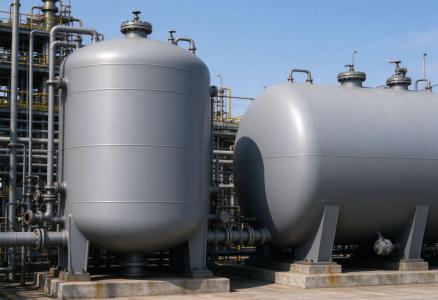
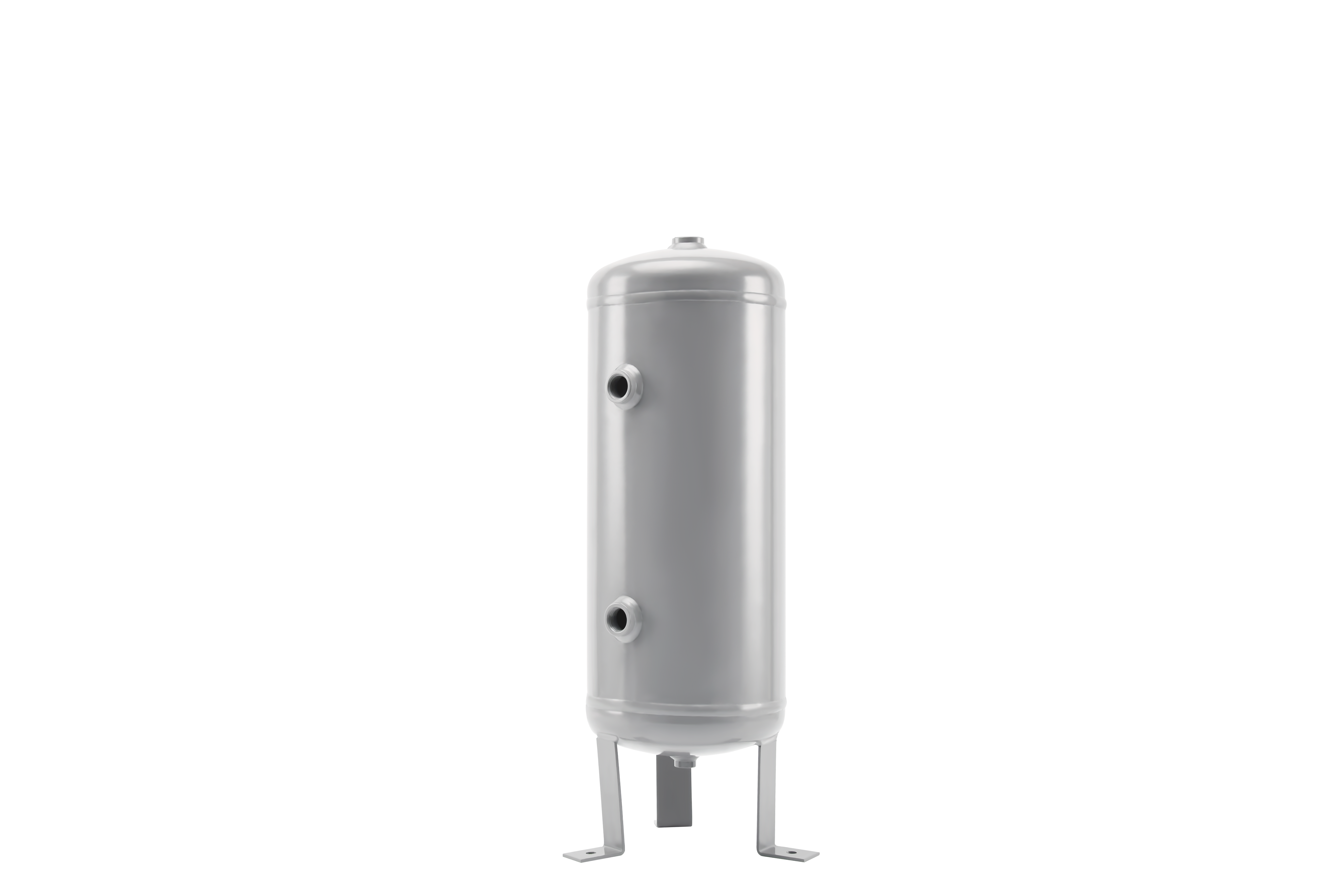
Practically, the difference between pressure vessel tank and storage tank shows up as a set of physical tells. A pressure vessel closes with a dished head, carries a stamped nameplate with MAWP and design temperature, bears a code symbol such as U or UM, and arrives with design calculations and a witnessed test certificate. An atmospheric tank closes with a flat bottom and a cone or dome roof, breathes through a vent, and is judged mainly on whether the shell leaks and whether the foundation settles.
How Internal Pressure Changes Structural Design
Internal pressure changes structural design because it turns the shell from a container resisting weight into a membrane carrying stress in two directions at once, and every nozzle, support and weld detail then has to be shaped around that stress field.
For a thin cylindrical shell, hoop stress equals pressure times diameter divided by twice the thickness, so at a fixed wall thickness a change from 1 bar to 10 bar multiplies stress by ten. A 1 m diameter shell at 10 bar with a 6 mm wall sits near 83 MPa of hoop stress before any corrosion allowance, joint efficiency or nozzle compensation is applied, which is why a geometry that looks generous for water storage becomes marginal for compressed air. Longitudinal stress runs at half the hoop value, but openings do not: a threaded port or welded saddle concentrates stress locally, which is what drives the reinforcement pad or forged nozzle neck.
Compressed air adds a load case atmospheric tanks never see. A receiver downstream of a reciprocating compressor may pass through several thousand pressure cycles a year, and each cycle is a small fatigue event at welds and nozzle corners. Storage tanks are designed around hydrostatic head, wind, seismic and settlement instead, with ring stiffeners and shell courses stepping down from bottom to top. The structural vocabulary differs because the dominant load differs.
The consequence for a buyer is straightforward: a vessel quotation should include a nozzle schedule and a reinforcement detail for every opening above a stated size, while a pressure air storage tank quotation should include vent size, roof live load and foundation ring dimensions.
Wall Thickness and Head Design Differences
Wall thickness and head design differ because a pressure vessel must close its shell with a curved form that carries membrane stress efficiently, while a storage tank closes with a flat bottom and a lightly loaded roof that carries almost none.For vessels, ASME Section VIII Division 1 gives the circumferential stress equation in UG-27, where thickness equals pressure times radius divided by allowable stress multiplied by joint efficiency, minus 0.6 times the pressure. Three inputs drive the result: allowable stress at design temperature, joint efficiency following from radiography extent, and the corrosion allowance agreed for the service. A fully radiographed vessel in SA-516 Grade 70 can run a joint efficiency of 1.0, spot radiography drops it to 0.85 and no radiography to 0.70 - a forty percent swing in required thickness from the same drawing.
Head geometry follows pressure as well. Two-to-one semi-ellipsoidal heads dominate the 1 to 10 bar band because they are cheap to form and reasonably efficient. Hemispherical heads take over at high pressure, where extra forming cost is repaid by a thinner head. Torispherical, or flanged and dished, heads are the economical compromise at small diameters and moderate pressure, and flat heads survive only at low pressure with calculated reinforcement or stay bolts. Storage shells are built from courses rather than one calculation: the bottom course is thickest, each course above steps down, and thickness is usually governed by code minimum and handling stiffness long before stress becomes interesting.
Testing, Inspection, and Certification Considerations
Testing and certification differ because a pressure vessel's credible failure mode is a sudden release of stored energy, so the code requires an independent witness of the pressure test, while an atmospheric tank is judged on leakage, settlement and shell distortion.
A vessel leaves the shop only after a hydrostatic test at 1.3 times the maximum allowable working pressure, held long enough to inspect every joint, with gauge reading and holding time charted. A pneumatic test at 1.1 times MAWP is permitted but treated as hazardous, because compressed gas stores far more energy than water at the same pressure. Radiography, ultrasonic or penetrant examination follows the joint efficiency the designer claimed, and post-weld heat treatment is triggered above stated thickness and material combinations. The evidence pack ends with a nameplate, a U or UM symbol, a national board registration number, and for export markets a CE marking under the Pressure Equipment Directive, a CRN registered to CSA B51 for Canada, or UKCA marking for the United Kingdom.
| Decision point | Pressure vessel (ASME VIII Div. 1) | Atmospheric storage tank (API 650) |
|---|
| Design pressure | Above 15 psig (103 kPa); PED from 0.5 bar gauge | Near atmospheric, typically capped close to 2.5 psi |
| Thickness basis | Pressure, radius, allowable stress, joint efficiency | Code minimum plate plus liquid head, wind, seismic |
| Pressure test | Hydrostatic at 1.3 x MAWP, witnessed and charted | Leak and settlement check, not a code pressure test |
| Evidence pack | Calculations, material certificates, NDE reports, test chart, nameplate | Material certificates, weld record, coating report |
YCZX has built to a standard pressure vessel code since 2013 - CE, ASME, CRN, DOHS and UKCA - with production split across plants in Kunshan, Jiangxi and Yangzhou. For buyers that matters less as a badge than as an audit trail: the certificate number on the nameplate should be traceable to a design calculation with your design pressure written into it.
What Buyers Should Specify When Purchasing a Tank or Vessel
A purchase specification is the document that fixes design pressure, design temperature, material grade, corrosion allowance, connection schedule and certification route, and it is also where the difference between tank and pressure vessel is settled for a specific project. It is the only reliable way to compare quotations that otherwise look identical.
Five items resolve most disputes before they reach a drawing:
Design pressure and maximum allowable working pressure stated separately, with the relief valve set point written down.
Design temperature range, because allowable stress falls with temperature and a cold-store tank is not a summer tank.
Material and corrosion allowance, including whether the wetted surface is painted, lined or left bare.
Nozzle schedule with size, type, orientation and any dip tube or anti-vortex requirement.
Certification route and destination market, since ASME, PED, CRN and UKCA each add different witness and documentation costs.
For compressed air duty most buyers end up choosing between a catalogue industrial air tank and a configured unit with auto-drain, multi-port connections and a specified internal finish. The catalogue route is faster and cheaper; the configured route earns its premium once the receiver sits downstream of a dryer that must hold a dew point, or once the tank has to fit a footprint no standard model matches.
FAQs About Difference Between Pressure Vessel and Storage Tank
1.Is a pressure vessel always a tank?
No. A tank is a shape; a pressure vessel is a classification. The same shell can be a receiver, a separator, a buffer or a reactor, and many tanks in the colloquial sense are not pressure vessels.
2.At what pressure does a storage tank become a pressure vessel?
In the United States the practical line is 15 psig, about 1 bar above atmosphere, under ASME Section VIII Division 1. In Europe the Pressure Equipment Directive starts at 0.5 bar gauge.
3.Can an air receiver be built to API 650 instead of ASME?
Only if it genuinely works near atmospheric pressure. A receiver holding 7 bar air cannot be justified under an atmospheric tank standard, and an inspector will reject the nameplate on that basis alone.
4.Does a CE-marked tank also need ASME for the United States?
Yes. CE marking satisfies European law and says nothing about US requirements. A vessel installed in the US normally needs an ASME stamp and a state or national board registration.
5.What is the difference between design pressure and working pressure?
Working pressure is what the process actually delivers; design pressure is the higher value the shell is calculated for, and MAWP is the maximum the completed vessel may legally see.
6.How much does certification add to price and lead time?
For a small receiver certification is a modest share of unit cost. For a large vessel with full radiography and a notified body witness it can dominate both cost and schedule, adding one to three weeks per approval route.
Conclusion
The difference between pressure vessel and storage tank is settled at the design stage, when someone writes a number on a specification sheet and accepts the code that number triggers. Below the threshold a tank is a volume holder judged by leaks and settlement; above it a vessel is a pressure boundary judged by calculations, radiography, a witnessed test and a traceable nameplate. Buying on drawing appearance alone is how projects end up with a shell that cannot be commissioned; if the duty is unclear, send the design pressure, volume and destination market to YCZX and the answer comes back as a drawing rather than an opinion.
References