1. The standards map: three families, four mating pairs
Threads mate in pairs, not by size. R1 is the external taper made for Rp; R2 is the external taper made for Rc. Both are 55° and both are 1:16, but Rp+R1 is a parallel-to-taper joint that needs sealant, while Rc+R2 seals metal-to-metal with a longer engagement. R1 screwed into Rc feels tight and holds nothing.
ZG is not NPT. Older Chinese drawings mark taper threads ZG. ZG belongs to the 55° R family — in practice the R1 external taper — while NPT is 60°. They look alike and are close in size, and they will not seal together. On YCZX drawings every port carries its standard; a drawing marked only "ZG" or "1/2" gets confirmed before quotation, not after production.
G and Rp are both parallel 55°, and they still do not seal each other. A G male screws into an Rp port, there is no taper to wedge, and the joint weeps. Parallel-to-parallel only seals when a gasket or O-ring sits on one face.
Europe and most export markets use G for gauge, drain and low-pressure ports, and Rp/Rc where the joint must seal on its own. North America uses NPT throughout. The Middle East and Southeast Asia mix the two, which is why the port list matters more than the market label.
2. Three tiers of risk, in order of severity
Tier 1 — the joint cannot hold (safety)
ZG supplied as NPT. Two or three turns, then binding — then seepage or a cracked boss. If that port carries the safety valve, the failure is an unset safety device, not a leak.
G used as a sealing thread. No gasket, tape only. It holds, weeps after the first pressure cycle, and reads as a tank defect.
R1 mated to Rc. The flanks never reach the interference the design assumes.
Tier 2 — nothing on site fits (cost and delay)
"1/2 inch" with no standard. G1/2, R1/2 and 1/2 NPT do not mate. This omission causes more installation returns than any manufacturing defect.
Instrument port specified apart from the instrument. A 1/4 NPT port on a plant that stocks G1/4 gauges is a guaranteed adapter purchase, or a returned tank.
Undersized safety valve port. The port has to pass the required relief flow; a port chosen for convenience is a compliance problem.
Tier 3 — the joint fails later (life)
Excess PTFE tape fragments into the line and backs the fitting out. Over-torque on a taper cracks the boss. Brass fittings in stainless ports corrode in humid or coastal plants — a real issue on our stainless receivers, less so on carbon steel with matching fittings. Unprotected threads arrive paint-filled and cost an hour per port.
3. The evidence layer
Three boundaries. G is fine for low-pressure compressed air — it is on receivers every day — but the gasket seals, not the thread. A thread is not a pressure rating: the rating comes from the fitting and the wall around the port, so a 1:16 taper does not create 35 MPa on its own.
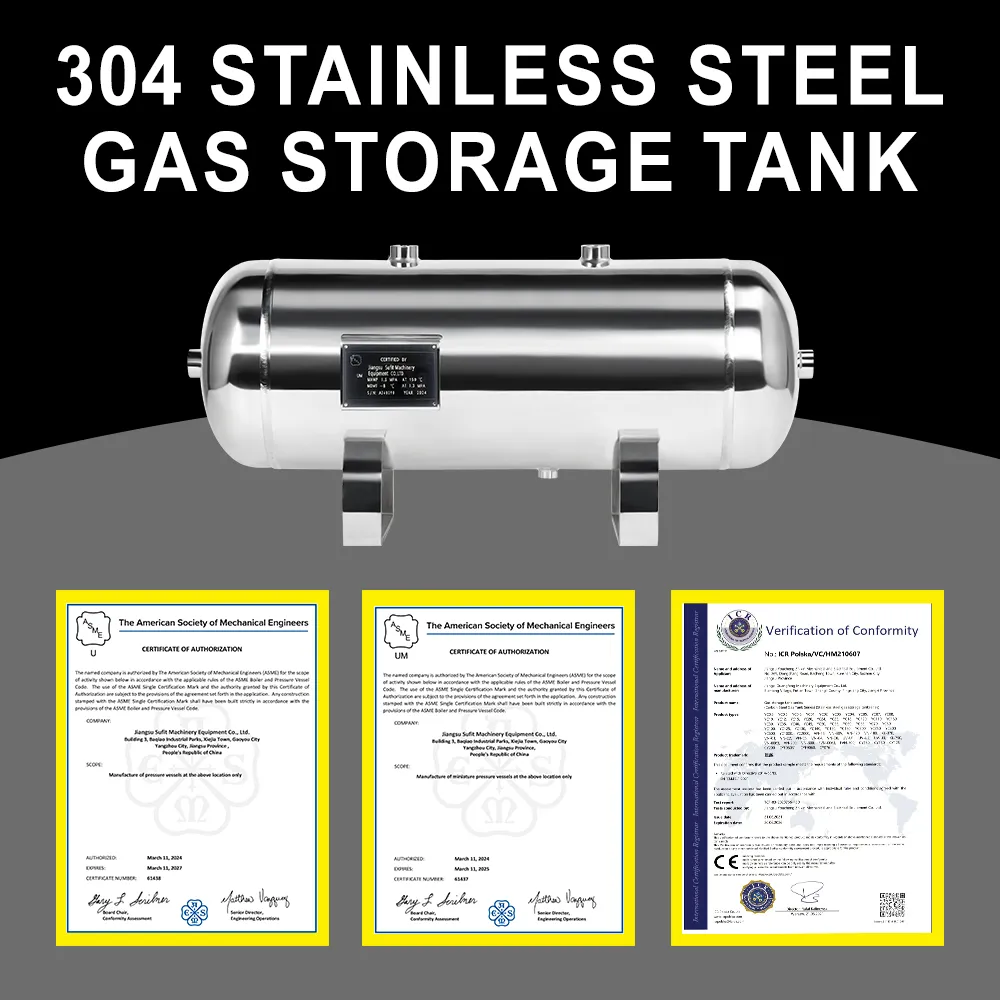
A thread is not a certification either. CE, ASME and DOSH apply to the vessel, not to the thread form. Every port is a pressure-boundary opening: it carries reinforcement, and it sits on the drawing that the U-1A and the technical file refer to. Re-cutting a port after certification is a design change, not a shop-floor fix — which is the practical reason the port list has to be right on the drawing. YCZX receivers are supplied with CE, ASME or DOSH as the destination requires; the port detail is part of what those documents cover.
Drawing checklist — six items, per port
Standard and size for each port: G1/2, Rp1/2, Rc1/2, R1/2, 1/2 NPT — never "1/2 inch"
Which ports must seal on their own, and which are fastening ports
The accessories to be fitted: gauge, safety valve, drain, inlet, outlet
Port material, so the fitting material can be matched
Protection caps and packing method
Test pressure, and the test record the buyer expects
Ports may follow different standards on one tank; what fails is mixing them without a label.
4. Summary
Three families, four pairs. G (ISO 228-1) never seals on its own; the R family (ISO 7-1) seals only as Rp+R1 or Rc+R2; NPT (ASME B1.20.1) seals by 60° interference.
Three mistakes to avoid. ZG is not NPT; G is not a sealing thread; R1 does not mate with Rc.
One document decides it. Six items per port on the drawing — standard, function, accessories, material, caps, test pressure.
One material rule. Match the fitting to the port; brass into stainless is a corrosion clock in humid plants.
Certification follows the vessel. CE, ASME and DOSH cover the receiver and its openings; none of them validates a thread form, and changing a port after certification is a design change.
Get those four right and the thread stops being a topic. On a receiver it is a five-minute decision on the drawing that determines whether commissioning takes an hour or a week.