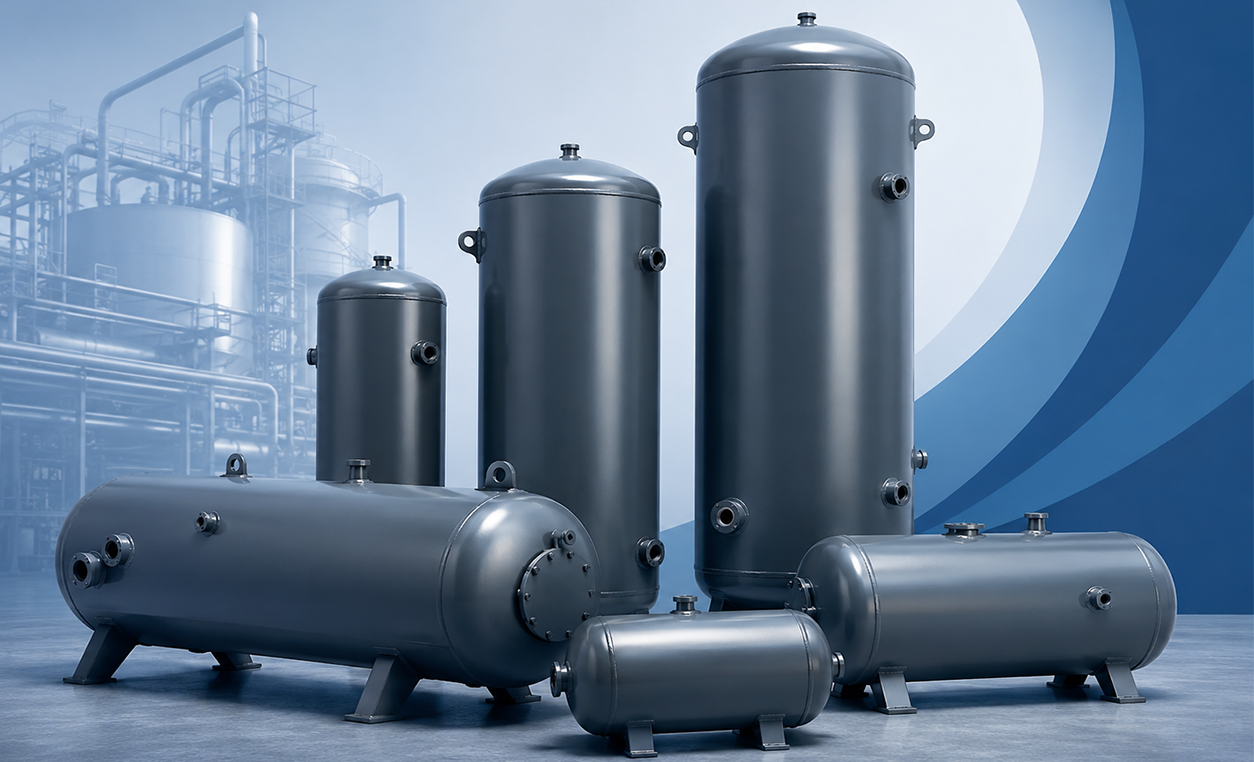
Flange connections are widely adopted on industrial air receivers for inlet, outlet, safety valve, pressure gauge, drain and manhole ports. They enable convenient disassembly for maintenance, component replacement and pipeline connection, compared with permanently welded joints. Different flange types, pressure classes and sealing designs directly affect tightness, safety and service life of pressure vessels.
Common Flange Types Used for Air Receivers
Weld Neck Flange (WN Flange)Preferred for high-pressure, export ASME/PED certified air receivers. Long tapered hub smoothly transfers stress to the tank nozzle. Excellent rigidity, anti-leakage performance, suitable for cyclic pressure fluctuation. The first choice for large-size and critical ports. Slip-on Flange (SO Flange)Cost-effective, easier to align during installation. Commonly used for medium-low pressure standard air receivers. Lower strength than weld neck type, not recommended for heavy vibration or high cyclic load conditions. Threaded FlangeNo welding required. Mainly applied for small auxiliary ports (G1/2, NPT connections). Restricted for low-pressure applications; not suitable for stainless steel tanks prone to thread seizure. Blind FlangeUsed to seal spare reserved nozzles on the tank, reserved for future pipeline expansion.
Key Selection Criteria
Pressure
Match flange rating with tank design pressure (Class 150 / 300 ASME standard; PN10 / PN16 European standard). Flange pressure rating must not be lower than the tank design pressure.
Material
Carbon steel tank: Carbon steel flange
304 stainless steel tank: 304 stainless steel flange
Avoid dissimilar metal contact to prevent galvanic corrosion.
RF Raised Face: Most universal, economical for general compressed air systems
RTJ Ring Type Joint: For high pressure & high temperature working conditions
Gasket
Rubber, non-asbestos or PTFE gaskets for normal temperature; metal spiral wound gaskets for high-temperature or high-pressure environments.
Advantages of Flange Connections
✅ Easy disassembly for overhaul, valve replacement and internal tank inspection✅ Standardized dimensions, compatible with global standard valves and piping✅ Reliable sealing when properly tightened✅ Convenient for project modification and pipeline layout adjustment
Precautions During Manufacturing & Installation
Flange shall be perpendicular to the nozzle centerline during welding to avoid sealing surface distortion.
Strict pre-weld cleaning for nozzle and flange weld joint to prevent welding defects.
Uniform diagonal bolt tightening to prevent uneven gasket compression and air leakage.
Regular bolt retightening is suggested after temperature cycling or long-time operation.
YCZX supplies air receivers equipped with customized flanges (WN, SO, threaded flanges) complying with ASME B16.5, EN standards. We offer matching flanges, gaskets and bolts according to your working pressure, medium and pipeline requirements for seamless on-site installation.