Fundamentals of Oil Free Vacuum Pumps: Definition and Core Concepts
Oil free vacuum pumps represent a significant advancement in pneumatic technology. These pumps operate without lubricating oil in the compression chamber. This design fundamentally changes how vacuum is created and maintained in various industrial applications. The core concept behind oil free technology is to use alternative methods to achieve vacuum without introducing oil into the process stream. This approach eliminates the risk of oil contamination while maintaining efficient vacuum performance.The fundamental difference between oil lubricated and oil free pumps lies in their internal workings. Oil lubricated pumps use oil to seal, cool, and lubricate internal components. Oil free pumps use specialized dry-running materials and precision engineering to achieve the same results without oil. This creates a cleaner operation environment and ensures that the vacuum produced does not contain oil particles or mist that could contaminate sensitive processes or end products.
Working Mechanisms of Different Oil Free Vacuum Pump Technologies
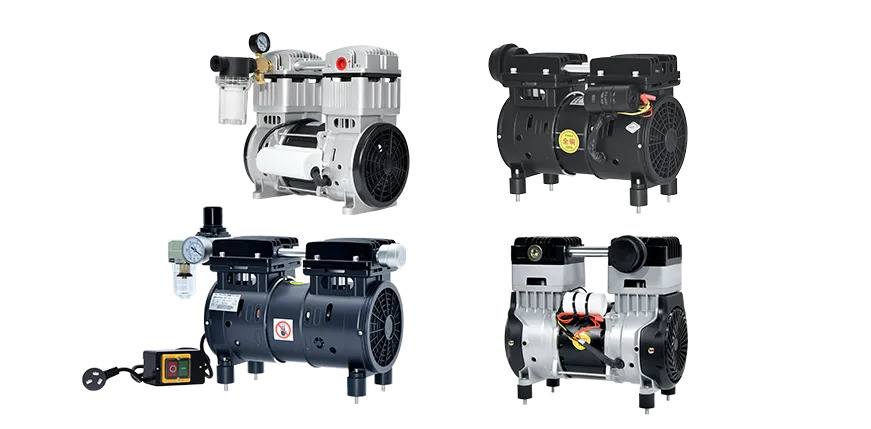
Oil free vacuum pumps employ several different technologies to achieve vacuum without oil. Each technology has unique characteristics that make it suitable for specific applications. Understanding these working mechanisms helps in selecting the right pump for a particular use case.Dry claw pumps use two rotors that intermesh but do not touch. As these rotors rotate, they trap gas between the rotors and the stator, compressing it and discharging it through outlets. This creates vacuum without the need for oil lubrication. The precision manufacturing of these components ensures minimal clearances while preventing mechanical contact.Scroll pumps utilize two spiral scrolls. One spiral remains fixed while the other orbits in a circular motion. This action creates moving compression pockets. Gas gets trapped between the scrolls and gradually moves to the center where it is compressed and discharged. This design provides smooth, pulse-free operation with very low vibration levels.Diaphragm pumps use a flexible diaphragm that moves up and down. As the diaphragm moves, it creates a volume change that draws in and expels gas. Check valves ensure unidirectional flow. This simple mechanism allows these pumps to handle contaminated gases that might damage other pump types.
Types of Oil Free Vacuum Pumps: Diaphragm, Scroll, and Claw Technologies
Oil free vacuum pumps are categorized into several types based on their operating principles. The three most common types are diaphragm, scroll, and claw pumps. Each type offers distinct advantages for different applications.Diaphragm vacuum pumps use a flexible diaphragm that moves up and down within a chamber. This movement creates alternating pressure changes that draw in and expel gas. Check valves ensure that gas flows in one direction only. Diaphragm pumps are compact, quiet, and require no lubrication. They can handle wet or corrosive gases and are often used in laboratories for applications like filtration and degassing.Scroll vacuum pumps utilize two precisely machined spiral scrolls. One scroll remains stationary while the other orbits in a circular path without rotating. This action creates a series of compression chambers that gradually move gas from the outer edges to the center. Scroll pumps offer smooth, pulse-free operation with very low noise levels. They achieve moderate vacuum levels and are commonly used in analytical instruments and clean applications.Claw vacuum pumps use two claw-shaped rotors that intermesh within a housing. As these rotors rotate, they trap gas between the rotors and the stator walls, compressing it and discharging it. Claw pumps offer high vacuum performance with oil-free operation. They can run continuously and are suitable for demanding industrial applications like packaging, drying, and filtration.
Industrial Applications of Oil Free Vacuum Pumps in Manufacturing
Oil free vacuum pumps have found widespread adoption across various manufacturing industries. Their ability to provide clean, oil-free vacuum makes them ideal for applications where contamination could compromise product quality or process integrity.In food and beverage manufacturing, oil free vacuum pumps are essential for packaging operations. Vacuum packaging extends product shelf life by removing oxygen and preventing bacterial growth. Oil free pumps ensure no oil contamination can taint food products. They are also used in freeze drying processes where even microscopic oil particles could affect product quality and safety.Pharmaceutical manufacturing relies heavily on oil free vacuum pumps for drug production and packaging. These pumps are used in tablet coating processes, freeze drying of pharmaceuticals, and vacuum packaging of medical supplies. The pharmaceutical industry adheres to strict contamination control standards, making oil free technology a necessity rather than an option.Electronics manufacturing requires ultra-clean environments where even microscopic contaminants can affect product performance. Oil free vacuum pumps are used in semiconductor manufacturing, circuit board production, and other processes where a vacuum is needed. Their oil-free operation ensures no contamination of sensitive electronic components.
Medical and Laboratory Uses for Oil Free Vacuum Technology
Medical and laboratory applications represent one of the most critical areas for oil free vacuum technology. These environments demand the highest levels of purity and reliability. Even trace amounts of oil contamination could compromise research results or patient safety.In medical laboratories, oil free vacuum pumps are essential for analytical instruments. Mass spectrometers, electron microscopes, and other sensitive equipment require clean vacuum environments. Oil contamination could affect instrument accuracy, shorten component life, or compromise analytical results. Oil free pumps provide the contamination-free operation these instruments require.Medical vacuum systems in hospitals and clinics often utilize oil free technology. These systems power surgical suction devices, wound drainage systems, and other medical equipment. The absence of oil contamination ensures patient safety and reduces the risk of infections or other complications that could arise from contaminated equipment.Research laboratories across various scientific disciplines rely on oil free vacuum pumps. They are used in sample preparation, analytical chemistry, materials science, and many other applications. Research integrity is paramount, and oil free vacuum technology ensures that experimental results are not compromised by contamination from pump oil.