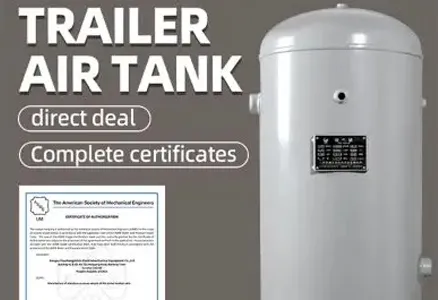
An air receiver tank—also known as a compressed air storage tank—is a specialized pressure vessel designed to store compressed air. It is typically used in conjunction with air compressors, refrigerated dryers, filters, and other auxiliary equipment to form a complete compressed air station, which serves as a critical power source in industrial production systems.
An air receiver tank primarily consists of three key components:
(1) Tank Body
Depending on the selected material, air receiver tanks can be classified into carbon steel tanks, low-alloy steel tanks, and stainless steel tanks. Carbon steel and low-alloy steel tanks are commonly used across many industries due to their cost-effectiveness and mechanical strength. In contrast, stainless steel tanks are preferred in industries with stringent requirements for corrosion resistance and formability—such as the food & beverage, pharmaceutical, chemical, and microelectronics sectors—where high-performance materials are essential for equipment and mechanical components.
(2) Safety Valve
The safety valve is a critical safety device that ensures the safe operation of both the air receiver tank and the connected air compressor system. When the internal pressure of the tank reaches its preset upper limit, the safety valve automatically opens to release excess air and relieve pressure. Failure of the safety valve may result in over-pressurization, potentially causing weld seam failure, leakage, or even catastrophic tank rupture—posing serious safety hazards. Therefore, the safety valve plays an indispensable role in system integrity.
(3) Pressure Gauge
The pressure gauge serves as the primary indicator of the internal conditions within the air receiver tank—essentially acting as its “eyes.” By monitoring the gauge reading, operators can accurately track real-time pressure fluctuations inside the tank, enabling proper system management and timely intervention when necessary.